
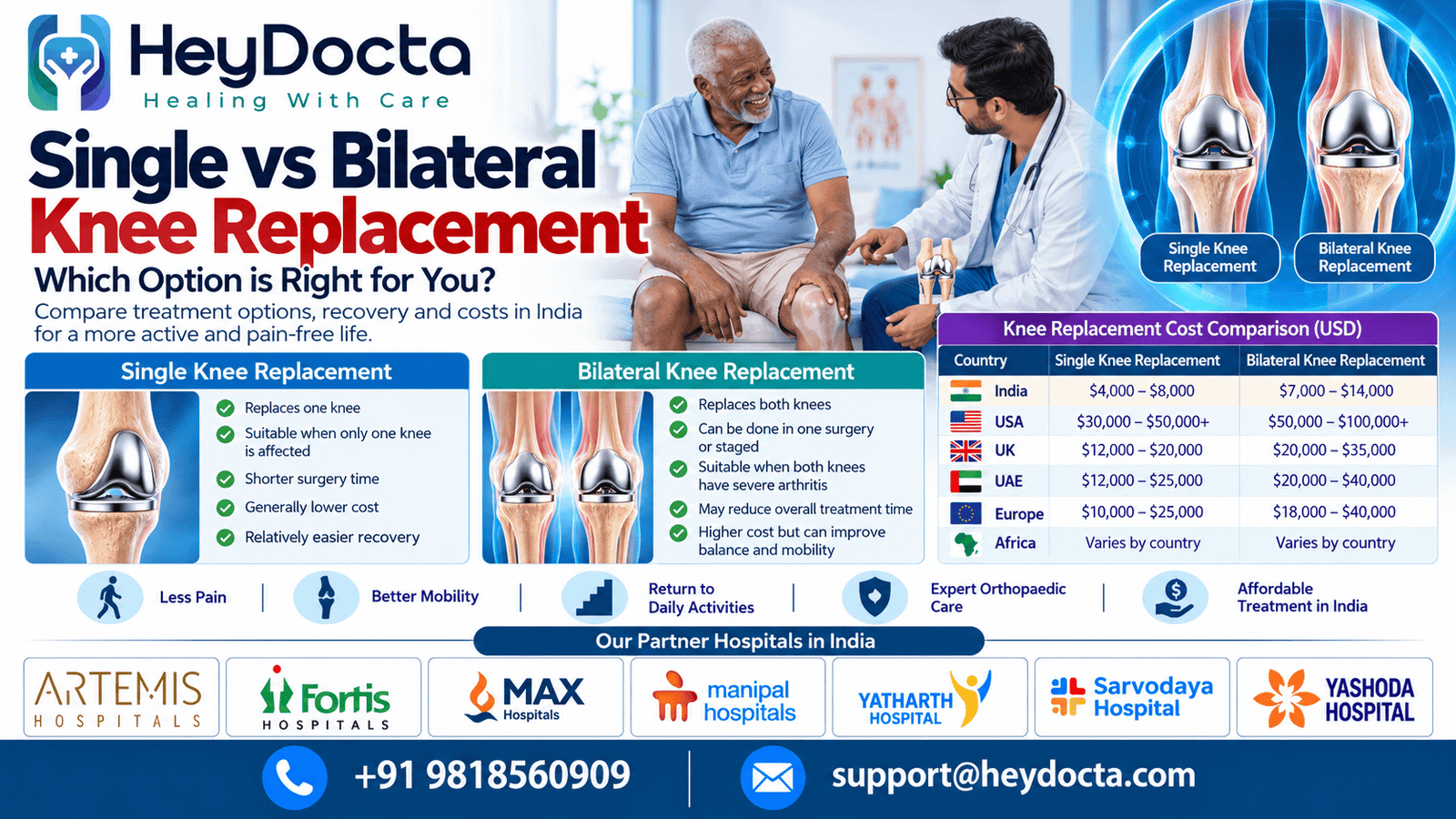
Single vs bilateral knee replacement is an important decision for patients with knee osteoarthritis who experience pain, stiffness and difficulty walking. If only one knee is severely affected, replacing a single knee may be sufficient. When both knees have advanced arthritis, patients may consider replacing both knees during one operation or undergoing two separate surgeries. The right option depends on joint damage, overall health, age, mobility and recovery needs.
For international patients from Nigeria, Ghana, Kenya, Zimbabwe, Cameroon, Guyana, Jamaica, the USA, Europe and the Middle East, India may offer comparatively affordable knee replacement treatment. This guide explains the differences between single and bilateral knee replacement, estimated costs across countries, recovery expectations and how to plan treatment in India.
Get a Free Medical Opinion : Contact HeyDocta to request a medical opinion and compare treatment estimates from partner hospitals in India.
What Is Single Knee Replacement?
Single knee replacement, also called unilateral knee replacement, involves replacing the damaged joint surfaces of one knee with artificial components. It is generally considered when osteoarthritis or another joint condition causes significant pain and disability in that knee.
A surgeon may recommend the procedure when:
- Knee pain interferes with walking, sleeping or everyday activities.
- Non-surgical treatments no longer provide sufficient relief.
- Imaging shows significant joint damage.
- The patient’s overall health makes surgery appropriate.
Single knee replacement usually requires rehabilitation focused on the operated leg. Patients may find it easier to manage recovery because the other knee can often provide support, although this depends on its condition and the patient’s general mobility.
What Is Bilateral Knee Replacement?
Bilateral knee replacement means replacing both knee joints. It can be performed in two main ways.
Simultaneous Bilateral Knee Replacement
Both knees are replaced during the same operation and anaesthetic. This approach may suit carefully selected patients who are healthy enough to tolerate a longer operation and more demanding early rehabilitation.
Potential advantages include one hospital admission and one main rehabilitation period. However, simultaneous surgery can place greater demands on the heart, lungs and circulatory system and may increase certain complications compared with operating on one knee. Careful patient selection is essential.
Staged Bilateral Knee Replacement
In staged surgery, one knee is replaced first and the second knee is treated in a separate operation after an appropriate recovery period. The interval varies according to the patient’s health, recovery and surgeon’s advice.
Staged surgery allows patients to recover from the first procedure before undergoing the second. However, it involves separate surgical episodes and may require additional travel, hospital admission and rehabilitation.
Single vs Bilateral Knee Replacement: Key Differences
| Feature | Single knee replacement | Bilateral knee replacement |
| Number of knees treated | One | Both |
| Surgical approach | One knee operation | Simultaneous or staged operations |
| Initial recovery | Usually less demanding | Often more demanding, especially if simultaneous |
| Hospital admission | Usually one admission | One admission if simultaneous; separate admissions if staged |
| Rehabilitation | Focuses on one knee | Requires recovery of both knees |
| Overall cost | Generally lower | Generally higher |
| Suitability | One knee needs replacement | Both knees need replacement and the patient is suitable |
Neither option is automatically better for every patient. The decision should be based on clinical assessment, expected benefits, surgical risks and the patient’s ability to participate in rehabilitation.
Which Option Is Better for Severe Knee Osteoarthritis?
The best option depends on how severely each knee is affected and how well the patient can manage surgery and recovery.
Single knee replacement may be appropriate when one knee causes most of the pain and disability, while the other knee remains reasonably functional.
Bilateral knee replacement may be considered when both knees have advanced arthritis, both cause significant symptoms and the patient is medically fit for treatment of both joints.
Patients with significant heart or lung disease, poorly controlled diabetes, anaemia, frailty or other major health concerns may require additional assessment before bilateral surgery. These conditions do not automatically rule out surgery, but they can affect the safest approach.
An orthopaedic surgeon should review X-rays, medical history, medications, mobility and relevant investigations before recommending a treatment plan.
Knee Replacement Cost in India vs Other Countries
One reason international patients consider India is the potential difference in private healthcare costs. The actual price depends on the hospital, implant, surgical technique, medical complexity and package inclusions.
The following figures are indicative planning estimates in USD, not guaranteed quotations or verified package prices from individual hospitals.
| Country | Single knee replacement | Bilateral knee replacement |
| India | $4,000–$8,000 | $7,000–$14,000 |
| USA | $30,000–$50,000+ | $50,000–$100,000+ |
| UK, private treatment | $12,000–$20,000 | $20,000–$35,000 |
| UAE, private treatment | $12,000–$25,000 | $20,000–$40,000 |
| Europe, private treatment | $10,000–$25,000 | $18,000–$40,000 |
Prices vary substantially between providers and countries. These ranges are not necessarily based on identical implants, hospital stays, surgical techniques or rehabilitation services. Public healthcare eligibility and insurance coverage may also change the amount a patient pays.
For patients travelling from African countries, Guyana, Jamaica or the Middle East, comparing treatment abroad with local care should include airfare, accommodation, visa costs, meals and follow-up arrangements—not just the hospital package.
Is Bilateral Knee Replacement Cheaper Than Two Separate Operations?
Simultaneous bilateral knee replacement may reduce some duplicated expenses, such as separate hospital admissions and certain operating or anaesthesia charges. However, it does not simply cost the same as one knee replacement, and additional care may be needed.
Staged surgery may involve two admissions, separate travel arrangements and two rehabilitation periods. It may nevertheless be the more appropriate option for some patients because of their medical condition or surgical risk.
Ask the hospital for separate estimates for simultaneous and staged bilateral surgery before making a decision.
What Affects the Total Cost?
The final cost of single or bilateral knee replacement can depend on:
- Type and manufacturer of the knee implant.
- Conventional, computer-assisted or robotic-assisted surgery.
- Surgeon, anaesthesia and operating theatre fees.
- Hospital room category and admission duration.
- Preoperative tests and treatment of existing conditions.
- Medicines, physiotherapy and rehabilitation.
- Additional hospital days or complications.
- Travel, accommodation and follow-up expenses.
Robotic-assisted surgery may increase the package price, and it is not necessary for every patient. Ask the surgeon whether it offers a meaningful advantage for your specific case.
Need a personalised cost estimate? HeyDocta can help coordinate enquiries with its partner hospitals and clarify what is included in the quoted treatment package.
Orthopaedic Consultation and Partner Hospitals in India
Patients considering knee replacement at Yatharth Hospital can enquire about Dr. Dhananjay Sabat and the hospital’s current joint replacement services. Confirm his current role, availability, relevant experience and suitability for your case directly with the hospital.
HeyDocta’s partner hospital network includes:
- Artemis Hospitals
- Fortis Hospitals
- Max Hospitals
- Manipal Hospital
- Yatharth Hospital
- Sarvodaya Hospital
- Yashoda Hospital
Availability of particular surgeons, implants, robotic systems and rehabilitation services may vary. Patients should request a current treatment plan and written estimate before booking travel.
Treatment Process for International Patients
Step 1: Share Medical Reports
Provide recent knee X-rays, medical history, current medication details and previous treatment records. The specialist may request additional tests.
Step 2: Obtain a Specialist Opinion
The orthopaedic team assesses whether one or both knees need replacement and discusses simultaneous versus staged surgery where relevant.
Step 3: Compare Treatment Estimates
Review the proposed procedure, implant, expected admission, rehabilitation arrangements and package exclusions.
Step 4: Arrange Visa and Travel
Check the latest Indian visa requirements for your nationality and obtain the necessary hospital documents. Confirm the treatment schedule before booking non-refundable travel.
Step 5: Surgery and Rehabilitation
After surgery, the medical team monitors recovery and begins mobilisation and physiotherapy when appropriate. Follow instructions for wound care, medication, walking support and exercises.
Step 6: Plan Your Return Home
Obtain discharge records, implant details, medication instructions and a rehabilitation plan. The surgeon should confirm when you are medically fit to fly and explain how follow-up care will be arranged.
HeyDocta can assist with hospital coordination, appointment scheduling, treatment estimates and travel guidance. Its medical tourism facilitation is provided without an additional facilitation charge to patients. Hospital treatment, investigations, medicines, flights, visas, accommodation and other third-party expenses remain separate.
Recovery After Single vs Bilateral Knee Replacement
Recovery differs according to the procedure, overall health and rehabilitation progress.
After single knee replacement, patients often begin walking with assistance within the first day or two when medically appropriate. Rehabilitation focuses on reducing swelling, improving knee movement and strengthening the operated leg.
After simultaneous bilateral knee replacement, both knees need rehabilitation at the same time. Early movement and transfers may be more difficult, and some patients need additional assistance or rehabilitation support.
With staged bilateral surgery, the second operation takes place after an appropriate interval determined by the surgeon. Patients should discuss the likely total treatment timeline before travelling.
Many people improve gradually over several weeks and months, but recovery is individual. International patients should not plan their return flight around a fixed number of days; the treating team must assess fitness to travel.
Frequently Asked Questions
1. Is single or bilateral knee replacement better?
Single replacement may be suitable when one knee is affected. Bilateral surgery may be considered when both knees have severe arthritis and the patient is fit for the procedure. A specialist should assess individual risks and needs.
2. Is bilateral knee replacement more expensive?
Yes, it generally costs more than replacing one knee. Simultaneous surgery may reduce some duplicated expenses, but the final price depends on the hospital, implants and care required.
3. Is simultaneous bilateral knee replacement safe?
It can be appropriate for carefully selected patients, but it may carry greater risks and require more demanding rehabilitation than single-knee surgery. Medical assessment is essential.
4. How long does recovery take?
Many patients make progress over several weeks, with further improvements over several months. Bilateral surgery may require more assistance during early recovery.
5. Can international patients travel to India for bilateral knee replacement?
Yes, eligible international patients can seek assessment in India. They should obtain a specialist opinion, a written cost estimate and a travel plan that includes postoperative recovery and follow-up.
6. Does HeyDocta charge patients for facilitation?
HeyDocta provides medical tourism facilitation without an additional facilitation charge to patients. Hospital treatment and other third-party expenses are separate.
Conclusion
The choice between single and bilateral knee replacement depends on the condition of each knee, overall health, expected benefits, surgical risks and recovery support. India may provide comparatively affordable options for international patients, but the lowest price should not be the only deciding factor.
Compare the proposed procedure, implant, surgeon, hospital care, rehabilitation and total travel budget before making a decision.
Contact HeyDocta.com to request a medical opinion, compare treatment estimates from partner hospitals and plan your knee replacement journey in India.