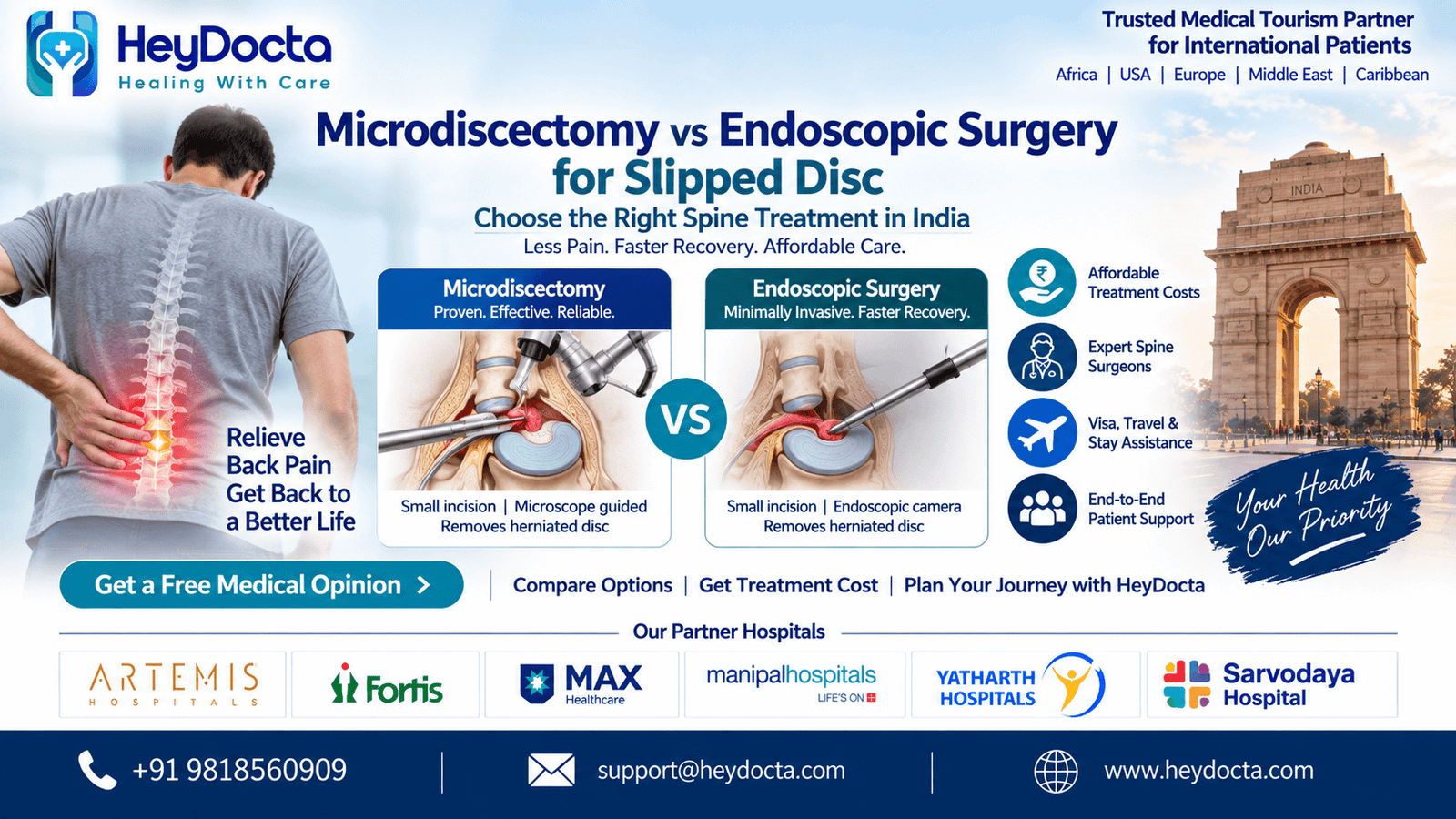
If a slipped disc is causing persistent back pain, leg pain, numbness or weakness, surgery may sometimes be recommended after appropriate evaluation and non-surgical treatment. Two commonly discussed options are microdiscectomy and endoscopic spine surgery. For international patients from Nigeria, Guyana, Jamaica, Kenya, Ghana, Zimbabwe, Cameroon, the Middle East, Europe and the USA, India offers both techniques at comparatively affordable private-hospital costs.
The important question is not simply which surgery costs less. The right procedure depends on the location and size of the disc herniation, symptoms, MRI findings, spinal anatomy, previous treatment and the surgeon’s assessment.
Get a Free Medical Opinion: Share your MRI and medical reports with HeyDocta to explore suitable treatment options and indicative hospital costs in India.
What Is a Slipped Disc?
A slipped disc, also called a herniated or prolapsed disc, occurs when part of a spinal disc moves beyond its normal position and may irritate or compress a nearby nerve.
Depending on the affected level, patients may experience:
- Lower back or neck pain
- Pain travelling into the leg or arm
- Numbness or tingling
- Muscle weakness
- Difficulty walking or performing daily activities
Not every slipped disc requires surgery. A spine specialist may first recommend medication, physiotherapy, activity modification or other conservative treatment. Surgery is generally considered when symptoms persist, neurological problems develop, or imaging and clinical findings indicate that disc removal may be appropriate.
Microdiscectomy vs Endoscopic Surgery: What Is the Difference?
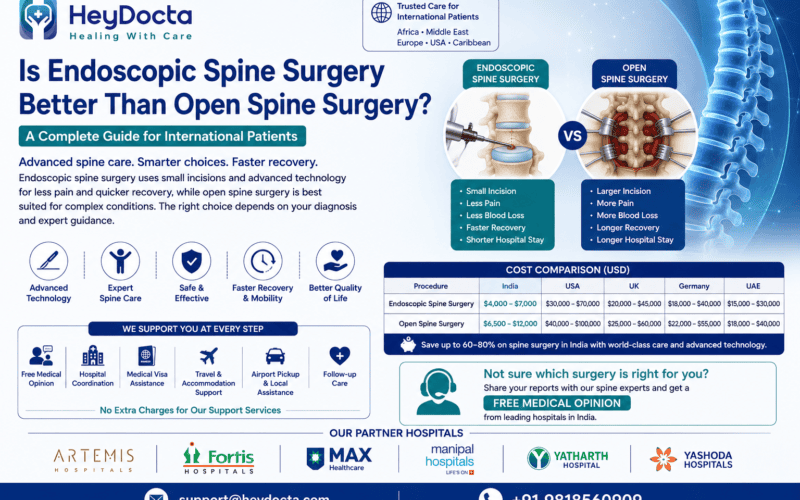
Both procedures aim to remove the portion of a herniated disc that is compressing a nerve. The main difference is how the surgeon reaches the affected disc.
| Feature | Microdiscectomy | Endoscopic Spine Surgery |
| Approach | Small incision with microscopic visualization | Small incision using an endoscope |
| Tissue disruption | Limited | Generally very limited |
| Surgical visualization | Microscope | Camera/endoscope |
| Hospital stay | Often short | Often short; some cases may be same-day |
| Recovery | Usually relatively quick | May be quicker in selected patients |
| Suitability | Many common lumbar disc herniations | Selected disc herniations depending on anatomy |
| Cost in India | Generally affordable | May cost slightly more depending on technology and hospital |
A 2026 systematic review and meta-analysis involving 4,186 patients found that full-endoscopic and microscopic lumbar discectomy were both safe and effective options for symptomatic lumbar disc herniation. The review found shorter hospital stays and earlier return to work with endoscopic surgery in the included studies, although endoscopic surgery was associated with a higher risk of postoperative dysesthesia in the analysis.
Another 2024 meta-analysis found that biportal endoscopic discectomy and microdiscectomy produced broadly comparable clinical outcomes, while endoscopic surgery was associated with shorter hospital stays and less blood loss in the studies reviewed.
This means endoscopic surgery should not automatically be considered better for every patient. Surgical selection should be based on the individual MRI, symptoms and surgeon’s assessment.
Microdiscectomy for Slipped Disc
Microdiscectomy is a well-established surgical technique used to remove the herniated portion of a disc that is pressing on a nerve.
The surgeon makes a small incision and uses a microscope or magnification to identify the affected area and remove the problematic disc fragment while preserving as much normal anatomy as possible.
Potential advantages
- Established surgical technique
- Suitable for many lumbar disc herniations
- Small incision compared with traditional open surgery
- Usually a relatively short hospital stay
- Can provide relief from nerve compression when appropriately indicated
Endoscopic Surgery for Slipped Disc
Endoscopic discectomy uses a small camera and specialised instruments introduced through a small access point. Endoscopic lumbar discectomy as a minimally invasive procedure using small incisions and an endoscope.
Potential advantages may include:
- Smaller access incision
- Less disruption of surrounding tissues
- Limited blood loss in appropriate cases
- Shorter hospital stay in many patients
- Earlier mobilisation for selected patients
However, endoscopic surgery requires specific equipment and appropriate surgeon experience, and not every disc herniation is suitable for an endoscopic approach.
Microdiscectomy vs Endoscopic Surgery: Which One Is Right?
There is no single procedure that is appropriate for every patient.
A spine surgeon may consider:
- Location of the disc herniation
- Size and direction of the disc fragment
- Nerve compression
- Severity and duration of symptoms
- Muscle weakness or neurological findings
- Previous spine surgery
- Number of spinal levels involved
- Overall health and other medical conditions
- Surgeon experience with the proposed technique
Recent evidence suggests that both microscopic and endoscopic techniques can achieve good outcomes for appropriately selected patients.
Microdiscectomy vs Endoscopic Surgery Cost in India
Cost is an important consideration for international patients. However, the final price depends on the hospital, surgeon, city, number of levels, diagnostic tests, room category, anaesthesia, hospital stay and any additional treatment required.
Current published estimates for international patients place microdiscectomy in India around $3,000–$7,500, while published estimates for endoscopic discectomy are commonly around $3,600–$6,000, although actual hospital quotations can vary considerably.
Indicative Cost Comparison
| Procedure | India | USA | UK |
| Microdiscectomy | $3,000–$7,500 | $20,000–$45,000 | Varies by provider |
| Endoscopic discectomy | $3,600–$6,000 | $25,000–$60,000 | $18,000–$35,000 |
| Lumbar decompression | $4,500–$7,500 | $35,000–$75,000 | $14,000–$24,000 |
These figures are indicative planning ranges, not quotations. Medical-tourism estimates show substantial variation, so international patients should compare what each package includes before making a decision.
For patients travelling from Africa, the Middle East, Europe, the USA or the Caribbean, India can therefore offer a potentially significant cost difference, but the total budget should also include flights, accommodation, visa fees, local transportation and follow-up arrangements.
What Makes Up the Total Treatment Cost?
Ask the hospital or medical facilitator whether the quotation includes:
- Surgeon fees
- Anaesthesia
- Operating-room charges
- Hospital room
- Medicines during admission
- Diagnostic tests
- Imaging
- Consumables
- Post-operative monitoring
- Physiotherapy, if required
- Follow-up consultation
A very low quotation may not include all of these items. Always request a written, itemised estimate.
Talk to a Medical Tourism Expert: HeyDocta can coordinate medical records with suitable hospitals and help international patients understand the expected treatment and cost before travelling.
Spine Surgeons and Hospitals in India
International patients can explore spine-care options through established hospitals with dedicated orthopaedic and neurosurgical services.
At Artemis Hospital, Gurugram, Dr. Hitesh Garg is listed as Head of Ortho Spine Surgery, and Artemis lists him among its specialists for endoscopic and minimally invasive spine surgery.
At Max Hospitals, Dr. Jitesh Manghwani is listed as Associate Director & Unit Head – Orthopaedic Spine Surgery. His listed areas of interest include microscopic keyhole surgery, disc herniation and endoscopic spine surgery.
HeyDocta’s partner hospitals include:
- Artemis Hospital
- Fortis Hospitals
- Max Hospitals
- Manipal Hospital
- Yatharth Hospital
- Sarvodaya Hospital
The appropriate hospital and surgeon should be selected according to the patient’s medical reports, treatment requirements, availability and budget rather than simply choosing a hospital based on name.
Treatment Process for International Patients
1. Share Medical Reports
Send MRI scans, previous medical records, prescriptions and relevant reports to HeyDocta.
2. Specialist Evaluation
The reports can be coordinated with an appropriate spine specialist for an initial medical opinion.
3. Treatment Plan and Cost Estimate
The hospital can provide a proposed treatment plan and estimated package based on the medical evaluation.
4. Hospital and Travel Planning
HeyDocta assists with hospital coordination and can help patients plan accommodation, airport transfers and other travel requirements.
5. Medical Treatment in India
After arrival, the patient undergoes an in-person consultation and any additional tests considered necessary. The final treatment decision is made by the treating medical team.
6. Recovery and Follow-Up
The surgeon provides discharge instructions, medication guidance and follow-up recommendations before the patient returns home.
Medical Visa and Travel Support
Patients travelling to India for treatment may be eligible for an e-Medical Visa, while eligible attendants can apply for an e-Medical Attendant Visa. The official Indian e-Visa portal currently lists these medical visa categories with multiple-entry provisions and a stated one-year validity framework, subject to the applicable rules.
Visa eligibility and documentation requirements can change, so patients should verify the latest requirements through the official Indian government portal before booking travel.
HeyDocta can assist with the practical coordination of medical documents, hospital communication and travel planning.
Recovery and Stay in India
Recovery varies according to the procedure, disc location, general health and individual healing.
For uncomplicated discectomy procedures, hospitalisation may be relatively short. Published international-patient planning ranges commonly indicate approximately 1–3 hospital nights for microdiscectomy, but this is not a fixed timeline.
International patients should not plan their return flight solely around the hospital discharge date. The treating surgeon should confirm when it is medically appropriate to travel, particularly after a long-haul flight.
Frequently Asked Questions
Is microdiscectomy better than endoscopic surgery?
Neither procedure is universally better. Both can be effective for appropriately selected lumbar disc herniation patients. The choice depends on MRI findings, symptoms, anatomy and surgeon expertise.
Is endoscopic surgery more expensive than microdiscectomy in India?
It can be, depending on the hospital, equipment, surgeon and complexity. Published estimates overlap, so patients should compare complete package costs rather than only the surgical fee.
How much does microdiscectomy cost in India?
For international patients, current planning estimates are approximately $3,000–$7,500, but the final price depends on the individual case and hospital package.
How much does endoscopic discectomy cost in India?
Estimated commonly range around $3,600–$6,000. Actual international-patient quotations can differ according to patient condition.
How long do international patients need to stay in India?
The hospital stay may be short for an uncomplicated discectomy, but international patients usually need additional time for post-operative review and safe travel planning. The treating surgeon should determine the appropriate travel timeline.
Can I get a medical opinion before travelling to India?
Yes. Patients can share MRI scans and medical reports for an initial review and treatment planning before travelling. A final diagnosis and surgical decision require appropriate clinical evaluation.
Does HeyDocta charge patients an extra service fee?
HeyDocta facilitates hospital and medical-tourism coordination. Where the applicable hospital/service arrangement provides facilitation without an additional patient service fee, patients are not charged separately for that service; this should be confirmed for the specific treatment and hospital before travel.
Why Consider India for Slipped Disc Treatment?
For international patients, the main advantages of considering India include access to multiple spine-care hospitals, different surgical approaches, experienced specialists and comparatively lower published treatment costs than many private healthcare markets.
However, affordability should be considered together with clinical suitability, hospital standards, surgeon experience, package inclusions and follow-up planning.
Conclusion
Microdiscectomy vs endoscopic surgery for slipped disc is not simply a comparison of old versus new surgery. Both techniques have an established role, and recent evidence indicates that appropriately selected patients can achieve good outcomes with either approach. Endoscopic techniques may offer advantages such as shorter hospital stays in selected cases, while microdiscectomy remains a widely used option for lumbar disc herniation.
For international patients from Nigeria, Guyana, Jamaica, Kenya, Ghana, Zimbabwe, Cameroon, the Middle East, Europe and the USA, India can provide access to multiple treatment options at comparatively affordable costs.
Get a Free Medical Opinion from HeyDocta. Share your MRI and medical reports with our team to explore suitable Indian hospitals, specialist opinions, treatment options and an indicative cost estimate. HeyDocta.com supports international patients with hospital coordination, treatment planning, visa assistance, travel arrangements and end-to-end medical tourism support, helping make the journey to India more organised and transparent.