If you are considering a bone marrow transplant in India, one of the most important questions is: “Is India safe for BMT treatment?” For international patients from Nigeria, Kenya, Ghana, Cameroon, Zimbabwe, Guyana, Jamaica, the Middle East, Europe and the USA, safety should be evaluated through the transplant centre’s infection-control systems, specialist team, donor-matching process, intensive monitoring and follow-up care—not simply by country. India also offers lower private-treatment costs than many Western markets, which can make BMT financially accessible for international patients.
HeyDocta helps patients review medical records, coordinate with Indian hospitals and specialists, understand estimated treatment costs, and arrange travel-related support.
Get a Free Medical Opinion | Talk to Our Medical Tourism Expert
Is Bone Marrow Transplant Safe in India?
Bone marrow transplant is a complex medical treatment regardless of the country where it is performed. The main safety considerations are the quality of the transplant centre, experience of the medical team, infection-control protocols, blood-bank support, donor matching, laboratory facilities, intensive care access and long-term follow-up.
The National Cancer Institute notes that stem cell transplantation can involve risks such as infection, bleeding, fatigue and graft-versus-host disease (GVHD), particularly after an allogeneic transplant. Immune recovery can take months or longer after transplantation.
Therefore, international patients should choose a hospital based on its transplant capabilities and individual medical requirements rather than relying only on cost.
Why International Patients Consider India for BMT
India has established hematology and bone marrow transplant programmes in major cities, including Delhi-NCR, Mumbai, Chennai, Bengaluru and Hyderabad.
International patients commonly consider India because of:
- Experienced hematology and BMT specialists
- Dedicated transplant units
- Advanced diagnostic and laboratory facilities
- Donor and HLA-matching services
- Intensive infection monitoring
- Availability of autologous and allogeneic transplantation
- Lower private-treatment costs compared with several Western countries
- International-patient coordination
- English-speaking medical teams in many major hospitals
NABH, India’s hospital accreditation body, states that its standards focus on patient safety, quality systems and reducing healthcare-associated infection risks. Its directory also allows patients to search healthcare organisations by accreditation and transplant services.
What Conditions May Require a Bone Marrow Transplant?
BMT or hematopoietic stem cell transplantation may be considered for selected patients with conditions such as:
- Acute leukemia
- Chronic leukemia
- Lymphoma
- Multiple myeloma
- Aplastic anemia
- Myelodysplastic syndromes
- Thalassemia
- Sickle cell disease
- Certain inherited immune or metabolic disorders
The decision depends on the patient’s diagnosis, disease status, previous treatment, age, general health and availability of an appropriate donor.
Artemis Hospitals, for example, lists transplantation for both malignant and non-malignant blood disorders, including leukemia, lymphoma, multiple myeloma, aplastic anemia, thalassemia and sickle cell disease.
Types of Bone Marrow Transplant Available in India
Autologous BMT
The patient’s own stem cells are collected, stored and later returned after high-dose treatment. There is no donor-matching requirement.
Allogeneic BMT
Stem cells are obtained from another person. The donor may be a matched sibling, unrelated donor or partially matched family member.
Haploidentical Transplant
A partially matched family member can provide stem cells when a fully matched donor is not available.
The transplant type has a major effect on treatment complexity, hospital stay and total cost.
BMT Specialist in India: Dr. Gaurav Dixit
International patients can seek evaluation from specialist hematology and BMT teams in India.
Dr. Gaurav Dixit is Head – Haematology Oncology & Bone Marrow Transplant at Artemis Hospitals, Gurugram. His listed specialties include BMT, hematopoietic stem cell transplant, hematology, oncology and paediatric haemato-oncology.
His listed procedures include autologous stem cell transplant, matched sibling allogeneic transplant, haploidentical transplant and matched unrelated donor transplant. His profile also lists experience in leukemia, myeloma, lymphoma, aplastic anemia and other hematological disorders.
Artemis describes its BMT service as including dedicated transplant facilities, HEPA-filtered environments, specialist monitoring and infection-prevention measures.
How Safe Is BMT in India? Key Safety Factors
Instead of asking whether an entire country is “safe,” international patients should evaluate the following before choosing a hospital:
| Safety Factor | What Patients Should Check |
| Transplant team | Hematologists, transplant physicians and trained nursing staff |
| Infection control | Isolation facilities, air filtration and infection monitoring |
| Donor matching | HLA testing and appropriate donor evaluation |
| Blood bank | Availability of blood and platelet support |
| Laboratory | Rapid blood tests, microbiology and disease monitoring |
| ICU support | 24/7 critical-care access |
| Medicines | Availability of antibiotics, antifungals and immunosuppressants |
| Follow-up | Regular blood tests and post-transplant monitoring |
Patients should also ask which services are included in the quoted package and which expenses could be additional.
Bone Marrow Transplant Cost in India vs Other Countries
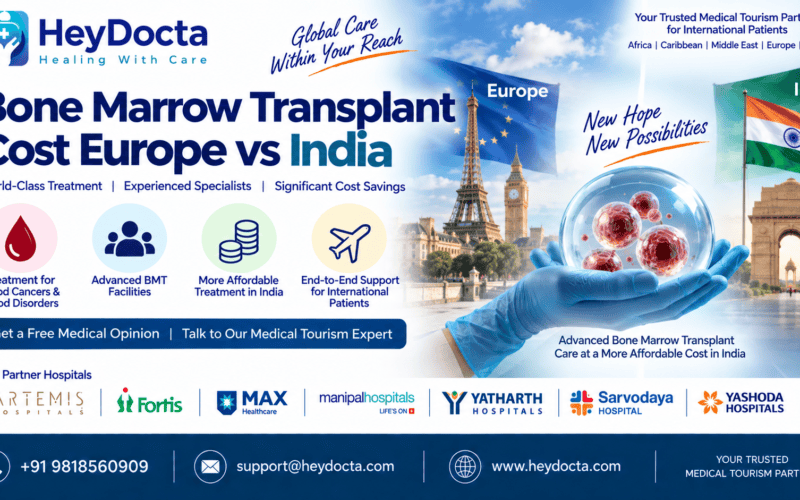
Affordability is one of the reasons international patients explore India. Apollo Hospitals currently publishes a general BMT cost range of approximately USD15,700 –31,500, with the final amount varying according to hospital, location, room type and complications.
For the USA, the U.S. Health Resources and Services Administration states that an unrelated bone marrow or cord-blood transplant can range from USD 240,000 to more than USD 1 million, including the transplant and up to six months of care.
| Treatment | India | Germany/Europe Example | USA |
| Autologous BMT | USD 25,560–59,510* | Germany: USD 101,700–236,940* | Can be substantially higher depending on coverage |
| Allogeneic BMT | USD 34,660–81,380* | Germany: USD 150,180–327,900* | USD 240,000–1M+ for unrelated transplant and up to 6 months care* |
Indicative figures only. Costs vary by country, diagnosis, donor type, hospital, medicines, length of stay and complications. European public or insurance-covered patients may have very different out-of-pocket expenses.
Talk to Our Medical Tourism Expert to receive a case-specific BMT cost estimate from Indian hospitals.
What Makes BMT Treatment Safer?
No transplant centre can eliminate every risk. However, appropriate systems can help identify and manage complications early.
Important measures include:
- Strict hand hygiene and infection-control protocols
- Protective isolation when required
- Regular blood-count monitoring
- Screening for bacterial, viral and fungal infections
- Appropriate antimicrobial medicines
- HLA and donor compatibility testing
- Blood and platelet transfusion support
- Monitoring for GVHD after allogeneic transplantation
- Nutritional support
- Access to intensive care when required
The NCI specifically highlights infection prevention and prompt management because patients can have weakened immunity during and after transplantation.
BMT Treatment Process for International Patients
1. Medical Record Review
Reports, diagnosis, pathology, imaging, previous treatment and blood tests are reviewed.
2. Specialist Consultation
A BMT specialist determines whether transplantation is appropriate and discusses available options.
3. Donor Assessment
For an allogeneic transplant, HLA testing and donor evaluation are performed.
4. Treatment Planning
The hospital provides a proposed treatment plan and estimated cost.
5. Medical Visa and Travel
HeyDocta can assist with hospital coordination, medical documentation, visa guidance, airport transfers and accommodation planning.
6. Conditioning Treatment
Chemotherapy, and sometimes radiation, may be given before stem-cell infusion.
7. Stem Cell Infusion
The stem cells are administered through an IV or central venous catheter. NCI notes that the infusion itself generally takes about one to five hours.
8. Engraftment and Monitoring
The transplant team monitors blood counts, infections and other complications while the new stem cells begin producing blood cells.
Recovery and Follow-Up After BMT
BMT requires more than the transplant-day procedure. Patients usually need close medical monitoring during the early recovery period and continued follow-up after discharge.
The NCI reports that immune recovery can take several months after autologous transplantation and one to two years after allogeneic or syngeneic transplantation.
International patients should therefore discuss:
- Expected hospital stay
- Accommodation after discharge
- Frequency of follow-up tests
- Blood transfusion requirements
- Infection precautions
- When air travel may be appropriate
- Whether follow-up can be shared with a doctor in the home country
How HeyDocta Supports International BMT Patients
HeyDocta provides medical tourism coordination for patients travelling to India, including:
- Hospital and specialist coordination
- Medical-record sharing
- Treatment-cost estimates
- Appointment scheduling
- Medical visa guidance
- Airport and local travel assistance
- Accommodation coordination
- Communication support
- Follow-up coordination
HeyDocta does not charge patients an additional fee for its coordination service. Hospital treatment, medicines, travel and accommodation costs remain separate and depend on the patient’s individual requirements.
FAQs About BMT Safety in India
1. Is India safe for bone marrow transplant?
Safety depends primarily on the transplant centre, medical team, infection-control systems, donor matching, monitoring and critical-care support. Patients should evaluate these factors before selecting a hospital.
2. Is BMT a high-risk treatment?
BMT is a complex treatment and can cause serious complications, including infections, bleeding, organ problems and GVHD after some allogeneic transplants.
3. How much does BMT cost in India?
A general published Indian estimate is approximately USD 15,700–31,500, although individual cases can cost more depending on transplant type and complications.
4. Which hospitals provide BMT in India?
International patients can explore BMT services at hospitals such as Artemis Hospital, Fortis Hospitals, Max Hospitals, Manipal Hospital, Yatharth Hospital, Sarvodaya Hospital and Yashoda Hospital, subject to specialist assessment and hospital acceptance.
5. Can international patients travel to India for BMT?
Yes, eligible international patients can seek treatment in India after medical evaluation and hospital acceptance, subject to applicable medical-visa requirements.
6. How long should I stay in India after BMT?
The required stay varies according to transplant type, recovery and complications. The treating transplant team should provide an individualized timeline.
7. Can HeyDocta help with BMT treatment in India?
Yes. HeyDocta can coordinate medical opinions, hospitals, appointments, cost estimates, visa guidance, accommodation and travel support.
Conclusion
For international patients asking “Is India safe for bone marrow transplant?”, the most useful approach is to evaluate the specific transplant centre rather than making a country-wide judgment. Look at transplant expertise, infection-control practices, donor matching, laboratory support, blood-bank facilities, critical care and long-term follow-up.
India can also offer a significant cost advantage for private BMT treatment compared with several international markets. However, the final treatment decision should always be made with a qualified hematologist or transplant specialist after reviewing the patient’s medical condition.
Get a Free Medical Opinion from HeyDocta.com and explore BMT treatment options, estimated costs and suitable Indian hospitals. Contact HeyDocta for end-to-end hospital coordination, medical-visa guidance and travel support.