Bone marrow transplant for AML in India can be an important treatment option for selected patients with acute myeloid leukemia (AML), particularly when the disease has responded to initial treatment and the medical team considers an allogeneic stem cell transplant appropriate. AML is an aggressive blood cancer that requires timely specialist evaluation, accurate disease classification and an individualised treatment plan. For international patients from Africa, the Middle East, Europe, the USA and other regions, India offers access to specialised hematology and BMT centres, with treatment costs that can be lower than many Western healthcare markets.
A transplant is not appropriate for every AML patient. The decision depends on AML subtype, genetic and molecular findings, remission status, age, overall health, relapse risk and donor availability.
Get a Free Medical Opinion: HeyDocta can coordinate your medical records with Indian hematology and BMT specialists, help identify suitable hospitals and obtain an indicative treatment-cost estimate.
What Is AML?
Acute myeloid leukemia (AML) is a cancer of the blood and bone marrow involving abnormal myeloid blood-forming cells. These abnormal cells can interfere with the production of normal red blood cells, white blood cells and platelets.
AML can cause symptoms such as:
- Persistent fatigue
- Fever or recurrent infections
- Easy bruising
- Bleeding
- Shortness of breath
- Pale skin
- Weakness
- Frequent illness
AML is not one single disease. Genetic, molecular and cytogenetic findings help doctors classify the disease and assess risk. The NCI notes that molecular testing for abnormalities such as NPM1, FLT3, CEBPA and RUNX1 is an important part of AML evaluation and prognosis.
When Is Bone Marrow Transplant Used for AML?
Treatment for AML may include chemotherapy, targeted therapy, supportive treatment and stem cell transplantation. The appropriate approach depends on the individual patient’s disease characteristics.
For patients who achieve remission, treatment may include consolidation chemotherapy or hematopoietic cell transplantation. Depending on the risk profile, an allogeneic stem cell transplant using donor cells may be considered.
Transplant decisions can be influenced by:
- AML genetic and molecular risk
- Response to induction treatment
- Minimal residual disease (MRD)
- Age and general health
- Previous treatment
- Availability of a suitable donor
- Risk of relapse
- Transplant-related risks
Therefore, patients should obtain a specialist opinion before travelling specifically for transplantation.
Why International AML Patients Consider India
Patients from Nigeria, Kenya, Ghana, Zimbabwe, Cameroon, Guyana, Jamaica, the Middle East, Europe and the USA may consider India because of:
- Specialised hematology and BMT departments
- Experienced transplant specialists
- Availability of matched and alternative donor transplantation
- Advanced diagnostic and molecular testing
- Dedicated transplant units
- Potentially lower treatment costs
- International patient coordination
- Medical visa assistance
- Travel and accommodation support
Cost is an important consideration, but it should never be the only factor when choosing an AML treatment centre.
Types of Stem Cell Transplant Used for AML
Allogeneic Stem Cell Transplant
In an allogeneic transplant, stem cells come from another person. The donor may be a matched sibling, matched unrelated donor or, in selected situations, a haploidentical family donor.
The donor’s immune system can contribute to an anti-leukemia effect, but allogeneic transplantation also carries risks such as infection and graft-versus-host disease.
Autologous Stem Cell Transplant
An autologous transplant uses the patient’s own stem cells. It may be considered in selected AML situations, depending on disease characteristics and remission status. The NCI lists both autologous and allogeneic transplantation among hematopoietic cell transplant approaches used in AML. (
Haploidentical Transplant
A haploidentical transplant uses a partially matched family donor. This can provide an additional donor option for selected patients when a fully matched donor is unavailable.
BMT in India for AML
International AML patients can seek evaluation from specialised hematology and BMT teams in India.
Dr. Gaurav Dixit is Head – Haematology Oncology & Bone Marrow Transplant at Artemis Hospitals, Gurugram. His official profile lists BMT, hematopoietic stem cell transplantation, hematology and oncology among his specialties. It also lists acute myeloid leukemia among his areas of expertise and includes matched-sibling allogeneic, haploidentical and matched-unrelated donor transplantation among his procedures.
Artemis Hospitals’ BMT division lists treatment for malignant and non-malignant blood disorders, including leukemia.
Patients should select a transplant specialist according to their AML subtype, treatment history, donor situation, transplant experience and individual medical requirements.
Bone Marrow Transplant Cost for AML in India
Treatment affordability is one of the major reasons international patients explore BMT in India.
Some Hospitals currently lists a general BMT cost of approximately USD15,700–31,500 in India, while noting that the actual cost depends on the hospital, location, room type and complications.
For 2026 planning, another India-focused cost source estimates approximately:
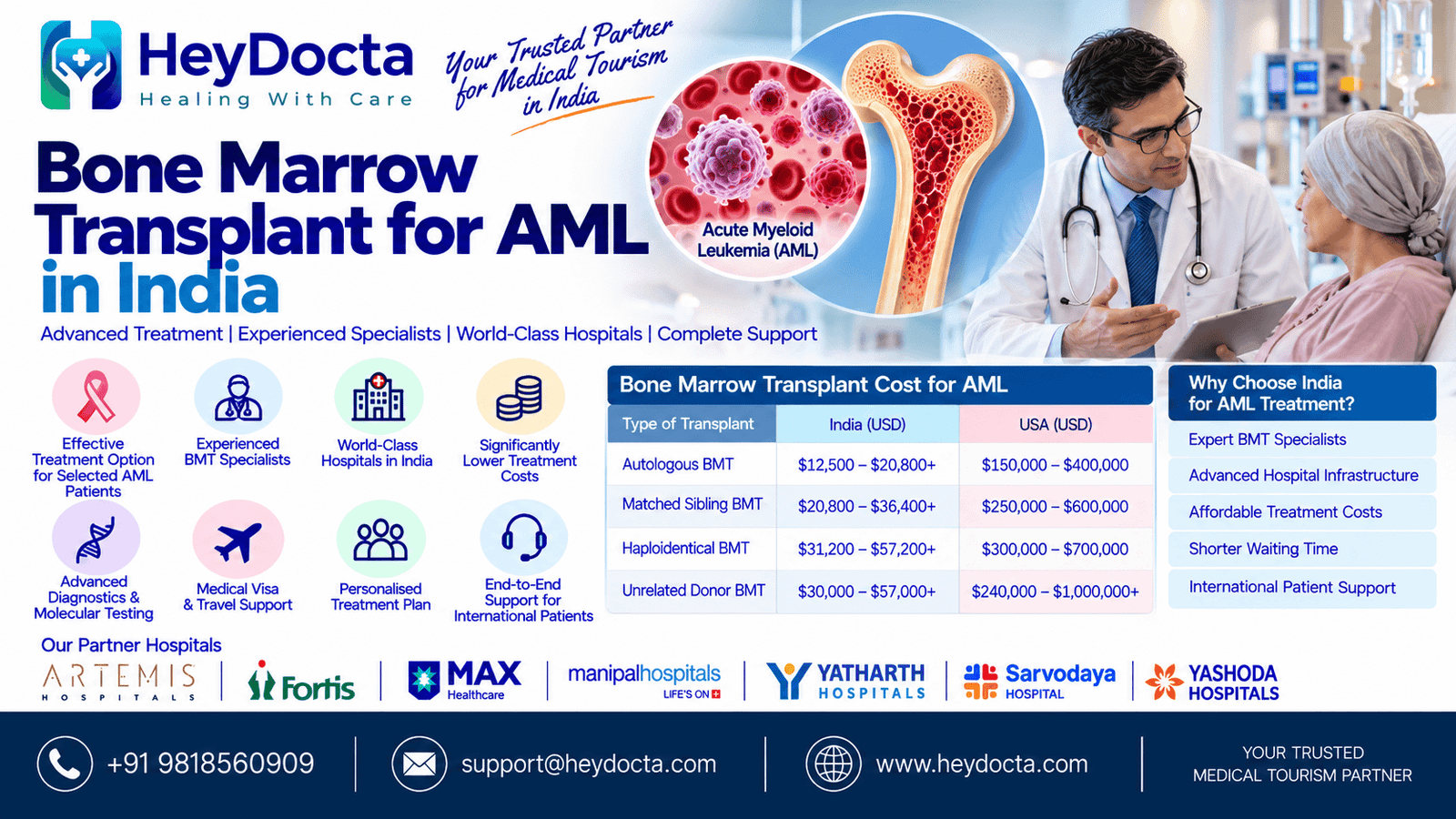
- Autologous BMT: USD 12,500–20,800
- Matched-related allogeneic BMT: USD 20,800–36,400
- Haploidentical/unrelated-donor or complex cases: USD 31,200–57,200+
These are planning ranges, not fixed quotations, and AML cases can require additional chemotherapy, donor testing, prolonged admission or management of complications.
India vs USA: Indicative Cost Comparison
| Treatment | India | USA |
| General BMT planning range | USD 12,500–57,200+ depending on type | Varies significantly |
| Matched-related BMT | USD 20,800–36,400+ | Higher in many settings |
| Complex/unrelated donor BMT | USD 31,200–57,200+ | Can be substantially higher |
| Unrelated BMT including extended care | Hospital-specific | USD 240,000 to $1M+ |
The U.S. Health Resources and Services Administration states that an unrelated bone marrow or cord blood transplant can cost USD 240,000 to more than USD 1 million, including the transplant and up to six months of care. Donor-search costs can add approximately USD 10,000 to more than USD 50,000 in some cases.
These figures are not directly equivalent package prices. Insurance coverage, hospital charges, post-transplant care and complications can substantially change a patient’s actual out-of-pocket cost in the USA.
What Is Included in AML BMT Cost?
The final cost may include:
- Pre-transplant investigations
- Bone marrow and molecular testing
- HLA typing
- Donor testing
- Conditioning chemotherapy
- Stem cell collection and processing
- Transplant procedure
- Protected/isolation room
- Medicines
- Blood and platelet transfusions
- Laboratory monitoring
- Infection prevention and treatment
- Engraftment monitoring
- Doctor and nursing charges
- Follow-up consultations
Additional costs can arise from ICU care, severe infections, graft-versus-host disease, prolonged hospitalisation or other complications.
Talk to Our Medical Tourism Expert: HeyDocta can help you obtain an itemised estimate from a suitable Indian hospital based on your AML diagnosis and treatment requirements.
Partner Hospitals for AML and BMT
Depending on the patient’s medical requirements and hospital availability, HeyDocta can coordinate enquiries with:
- Artemis Hospitals
- Fortis Hospitals
- Max Hospitals
- Manipal Hospitals
- Yatharth Hospitals
- Sarvodaya Hospital
- Yashoda Hospitals
There is no universal “best” hospital for every AML patient. The appropriate centre depends on the patient’s disease profile, transplant requirements, specialist expertise, donor availability and supportive-care facilities.
Step-by-Step AML Bone Marrow Transplant Process in India
Step 1: Send Medical Records
Patients can share pathology reports, bone marrow biopsy results, flow cytometry, molecular/genetic reports, imaging, blood tests and previous treatment details.
Step 2: Specialist Review
A hematology/BMT specialist reviews the case and determines whether transplantation should be considered.
Step 3: Donor Evaluation
Potential family donors undergo HLA testing. If a suitable family donor is unavailable, an unrelated donor search may be considered.
Step 4: Treatment and Transplant Planning
The hospital prepares an individual treatment plan, including conditioning, donor strategy, expected hospitalisation and estimated costs.
Step 5: Medical Visa and Travel
Eligible international patients can apply for an Indian e-Medical Visa. The Government of India’s e-Visa portal lists e-Medical Visa and e-Medical Attendant Visa categories and requires a hospital letter for the medical application.
The official portal currently states that eligible applicants can apply for e-Medical and e-Medical Attendant visas at least four days before arrival, with applications available up to 120 days before the proposed travel date.
Step 6: Conditioning and Transplant
The patient receives the prescribed conditioning treatment followed by stem cell infusion. Close monitoring is required during the early post-transplant period.
Step 7: Engraftment and Follow-Up
Blood counts, infections, organ function and other parameters are monitored until adequate recovery. Follow-up continues after discharge.
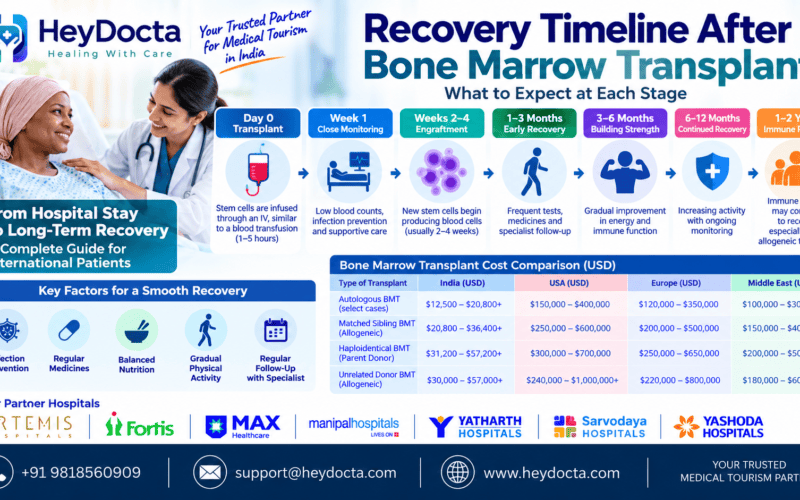
Recovery After AML Bone Marrow Transplant
Recovery varies from patient to patient. During the early period, patients may require:
- Frequent blood tests
- Anti-infective medicines
- Blood and platelet transfusions
- Nutritional support
- Monitoring for graft-versus-host disease
- Monitoring of organ function
- Regular hematology consultations
International patients should plan to remain in India for as long as their transplant team recommends. Return travel should be planned only after the treating team confirms that the patient is medically fit to travel.
How HeyDocta Supports International AML Patients
HeyDocta provides medical tourism coordination for patients travelling to India for complex treatments such as AML and BMT.
Support can include:
- Medical opinion coordination
- Hospital selection and coordination
- Specialist appointment scheduling
- Treatment-cost estimates
- Medical visa assistance
- Airport and local transportation support
- Accommodation assistance
- Attendant coordination
- Follow-up communication
HeyDocta does not charge patients an additional service fee for its medical-tourism facilitation, subject to the specific hospital and travel arrangements.
Frequently Asked Questions
Is bone marrow transplant used to treat AML?
Yes. Stem cell transplantation is one of the treatment approaches used for AML. Whether a patient should undergo transplant depends on disease risk, remission status, molecular findings, age, health and other factors.
Does every AML patient need a bone marrow transplant?
No. AML treatment is individualised. Some patients may receive chemotherapy, targeted therapy or other treatments without immediate transplantation.
How much does AML bone marrow transplant cost in India?
Indicative 2026 planning ranges are approximately USD 12,500–20,800 for autologous BMT, USD 20,800–36,400 for matched-related allogeneic BMT and USD 31,200–57,200+ for complex or alternative-donor cases. Actual hospital quotations can differ.
Is AML BMT cheaper in India than the USA?
Treatment can be substantially less expensive in India. HRSA reports USD 240,000 to more than USD 1 million for an unrelated U.S. transplant including up to six months of care.
What tests are needed before AML transplant?
Testing commonly includes blood investigations, bone marrow assessment, HLA typing, molecular/cytogenetic testing, infection screening and assessment of major organs. The exact tests depend on the patient.
Can international patients receive AML treatment in India?
Eligible international patients can travel to India for planned medical treatment, subject to current medical and visa requirements. The Indian e-Medical Visa process requires documentation from the treating hospital.
Can HeyDocta help with AML treatment in India?
Yes. HeyDocta can coordinate medical opinions, hospitals, specialists, treatment estimates, visa assistance, accommodation and travel-related support for international patients.
Conclusion
Bone marrow transplant for AML in India can be an option for selected international patients who require specialised hematology and transplant care. India offers multiple transplant approaches and experienced BMT teams, while treatment costs can be significantly lower than some Western healthcare markets.
However, AML is a complex and rapidly progressing disease. The most important first step is a detailed review by an experienced hematologist/BMT specialist. The transplant decision should consider AML subtype, genetic and molecular risk, remission status, MRD, donor availability, age, overall health and the risks and benefits of transplantation.
Get a Free Medical Opinion and AML Treatment Cost Estimate: Contact HeyDocta.com to share your medical records and connect with suitable Indian BMT specialists and hospitals. HeyDocta can support you from medical consultation and hospital coordination through visa, travel, treatment planning and follow-up.