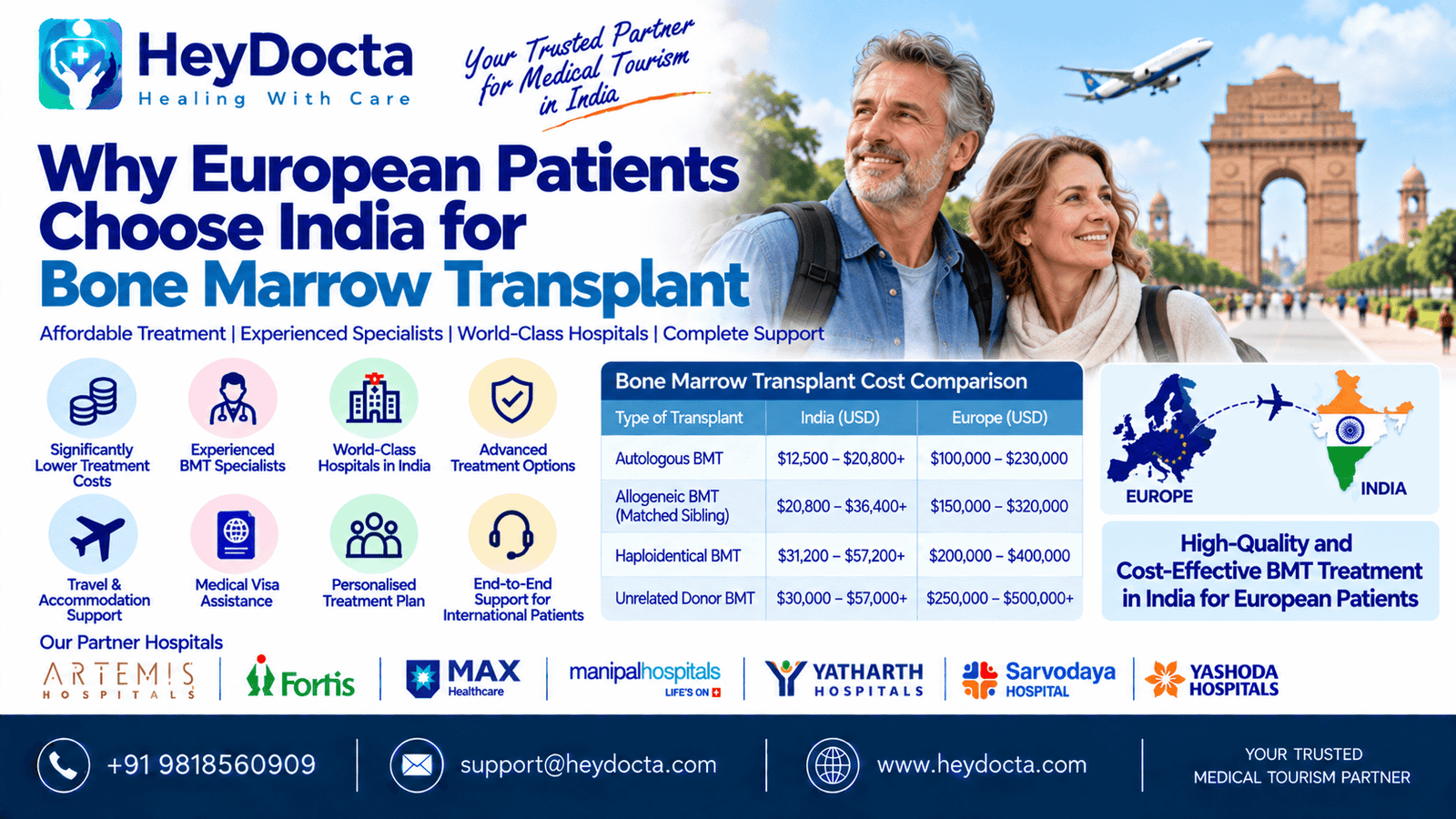
Bone marrow transplant, also called hematopoietic stem cell transplant (HSCT), can be an important treatment option for selected blood cancers and serious blood or immune disorders. For European patients, the treatment can involve significant medical, financial and logistical planning. This is one reason some international patients explore treatment options outside their home country, including India.
India offers specialised transplant centres, experienced hematology teams and a range of private hospitals. Cost is also an important consideration, although the final treatment decision should always be based on medical suitability, transplant expertise, infection-control facilities, donor availability, follow-up care and total treatment requirements.
Looking for a BMT option in India? HeyDocta.com can help international patients obtain medical opinions, coordinate with hospitals, understand estimated costs and arrange treatment-related travel support.
Why Do European Patients Consider India for Bone Marrow Transplant?
Several factors can influence a European patient’s decision to explore BMT in India:
- Lower treatment costs compared with many Western countries
- Access to specialised hematology and transplant teams
- Multiple transplant approaches, including autologous and allogeneic transplantation
- Private hospitals with dedicated transplant infrastructure
- Availability of international-patient coordination
- Assistance with medical documentation and hospital appointments
- Medical visa and travel coordination
- Options for accommodation and local support during longer stays
Cost should not be considered separately from clinical quality. Patients should compare what is included in each hospital quotation, including donor testing, medicines, hospitalisation, laboratory tests, blood products, complications and follow-up.
What Is a Bone Marrow Transplant?
A bone marrow transplant replaces diseased or damaged blood-forming stem cells with healthy stem cells. Depending on the patient’s disease and treatment plan, the stem cells may come from the patient or a donor.
The major types include:
Autologous Stem Cell Transplant
The patient’s own stem cells are collected before high-dose treatment and later returned to the bloodstream.
Allogeneic Stem Cell Transplant
Stem cells come from a donor. The donor may be a matched sibling, another matched donor or, in some situations, a partially matched family donor.
The choice depends on the disease, age, health status, donor availability, previous treatment and transplant team’s assessment.
Conditions Treated With Bone Marrow Transplant
BMT or HSCT may be considered for selected patients with conditions such as:
- Acute myeloid leukemia (AML)
- Acute lymphoblastic leukemia (ALL)
- Myelodysplastic syndromes
- Multiple myeloma
- Lymphomas in selected situations
- Aplastic anemia
- Thalassemia
- Sickle cell disease
- Certain inherited immune or bone marrow disorders
Not every patient with these conditions requires a transplant. A specialist must review the diagnosis, previous treatment, test results and overall health before recommending transplantation.
Bone Marrow Transplant Specialists in India
European patients can access specialised hematology and BMT teams across major Indian hospitals.
One specialist is Dr. Gaurav Dixit, Head – Haematology Oncology & Bone Marrow Transplant at Artemis Hospitals, Gurugram. His listed areas include hematopoietic stem cell transplantation, hematology, oncology and paediatric haemato-oncology. His listed transplant procedures include autologous, matched-sibling allogeneic, haploidentical and matched-unrelated donor transplantation.
Artemis also has a dedicated BMT division with specialists working across malignant and non-malignant blood disorders.
European patients should compare doctors based on relevant transplant experience, disease-specific expertise, transplant facilities, donor options, infection-control systems and continuity of care rather than relying only on online rankings.
Bone Marrow Transplant Cost in India vs Europe
Affordability is one of the major reasons international patients investigate India. However, prices vary considerably according to transplant type, donor matching, hospital, length of stay, medicines and complications.
Some Hospitals currently gives a general Indian BMT range of USD15,700–31,500, while other 2026 planning sources report wider ranges for complex donor transplants.
For international planning, approximate USD ranges can be presented as follows:
| Treatment | India – Indicative Cost | European Reference |
| Autologous BMT | USD 12,500–20,800+ | Germany: about USD 101,700–236,940 |
| Matched allogeneic BMT | USD 20,800–36,400+ | Germany: about USD 150,180–327,900 |
| Haploidentical / complex BMT | USD 31,200–57,200+ | Usually substantially higher in Western European private settings |
| Unrelated donor BMT | USD 30,000–57,000+ | Costs vary significantly by country and donor requirements |
The India figures are 2026 planning ranges and can increase when patients require unrelated donors, intensive infection management, ICU care, prolonged admission or treatment of complications.
MedCasts’ 2026 tracked packages, for example, place allogeneic BMT in India at approximately USD 34,660–81,380, compared with USD 150,180–327,900 in Germany. Its autologous figures range from USD 25,560–59,510 in India versus USD 101,700–236,940 in Germany. These are package-market estimates rather than guaranteed hospital quotations.
Therefore, European patients should request an itemised treatment estimate rather than comparing one headline price.
What Can Increase the Cost of BMT?
The final cost may depend on:
- Type of transplant
- Donor availability and HLA matching
- Donor search and collection
- Conditioning chemotherapy
- Hospital and isolation-room charges
- Blood and platelet transfusions
- Medicines and supportive care
- Laboratory and imaging tests
- Length of hospital stay
- Treatment of infections
- Graft-versus-host disease management
- ICU treatment, if required
- Post-transplant medicines and follow-up
A lower initial quotation does not necessarily mean a lower overall cost. Ask the hospital exactly what the package includes and excludes.
Hospitals Available for International Patients in India
HeyDocta can coordinate enquiries with partner hospitals, depending on the patient’s medical requirements and hospital availability. These include:
- Artemis Hospitals
- Fortis Hospitals
- Max Hospitals
- Manipal Hospitals
- Yatharth Hospitals
- Sarvodaya Hospital
- Yashoda Hospitals
The appropriate hospital should be selected after reviewing the patient’s diagnosis, transplant type, donor status, medical history and required treatment.
Step-by-Step BMT Journey for European Patients
1. Send Medical Records
Patients can provide diagnosis reports, pathology results, imaging, previous treatment details, blood tests and other relevant medical records.
2. Specialist Medical Review
A BMT specialist reviews the case and determines whether further investigations or a second opinion are required.
3. Hospital and Cost Planning
After medical review, suitable hospital options and an indicative treatment estimate can be discussed.
4. Travel and Medical Visa
India provides an e-Medical Visa route for eligible international travellers. The official Indian e-Visa portal states that e-Medical Visas are valid for one year from arrival with multiple entries; applicants also need a hospital letter and other required documents.
5. Treatment in India
The patient undergoes final investigations, conditioning and transplantation according to the specialist’s treatment plan.
6. Recovery and Follow-Up
BMT recovery can take weeks or months. Follow-up may include blood tests, medicines, infection monitoring and specialist consultations. Patients should not plan international travel until their treating team considers it medically appropriate.
Need help comparing hospitals and costs? Contact HeyDocta for a medical opinion, hospital coordination and an estimated treatment plan based on your medical records.
How HeyDocta Supports European BMT Patients
International patients may need help with much more than selecting a hospital. HeyDocta can support patients with:
- Medical opinion coordination
- Hospital and specialist coordination
- Treatment-cost estimates
- Appointment scheduling
- Medical visa assistance
- Airport and local travel coordination
- Accommodation assistance
- Attendant/family coordination
- Follow-up communication with the hospital
HeyDocta acts as a medical tourism facilitator and coordinates these services for international patients without an additional service charge to the patient, subject to the specific hospital and travel arrangements involved.
Frequently Asked Questions
Is bone marrow transplant cheaper in India than Europe?
India can be substantially less expensive than several Western European private-treatment markets, but the difference depends on the country, transplant type, donor requirements and complications. A personalised quotation is required for accurate comparison.
Can European patients get bone marrow transplant in India?
Yes, eligible international patients can seek planned medical treatment in India. Medical suitability and visa eligibility should be confirmed before travel.
How much does BMT cost in India?
Indicative 2026 planning ranges can start around USD 12,500–20,800 for autologous transplantation and around USD 20,800–36,400 for matched-related allogeneic transplantation. Complex donor procedures can cost more.
Who decides which type of BMT is required?
The treating hematology/BMT team determines the appropriate transplant type based on the disease, treatment history, donor availability and patient’s overall medical condition.
How long do international patients need to stay in India?
The duration varies significantly. It may include pre-transplant evaluation, conditioning, transplantation, engraftment monitoring and early follow-up. Patients requiring complications management may need a longer stay.
Can HeyDocta arrange treatment at an Indian hospital?
HeyDocta can coordinate medical opinions and hospital enquiries with its partner hospitals and assist international patients with treatment-related planning.
Conclusion
For European patients, India can provide access to specialised bone marrow transplant services with potentially lower treatment costs than several Western European private-care markets. The decision should, however, consider medical suitability, transplant expertise, donor requirements, hospital infrastructure, infection control, total treatment cost and long-term follow-up rather than price alone.
If you are considering bone marrow transplant in India, HeyDocta can help coordinate the medical opinion, hospital selection, estimated treatment cost, visa process, travel arrangements and international patient support.
Get a Free Medical Opinion and Treatment Cost Estimate from Indian BMT Hospitals. Contact HeyDocta today to start your treatment planning.