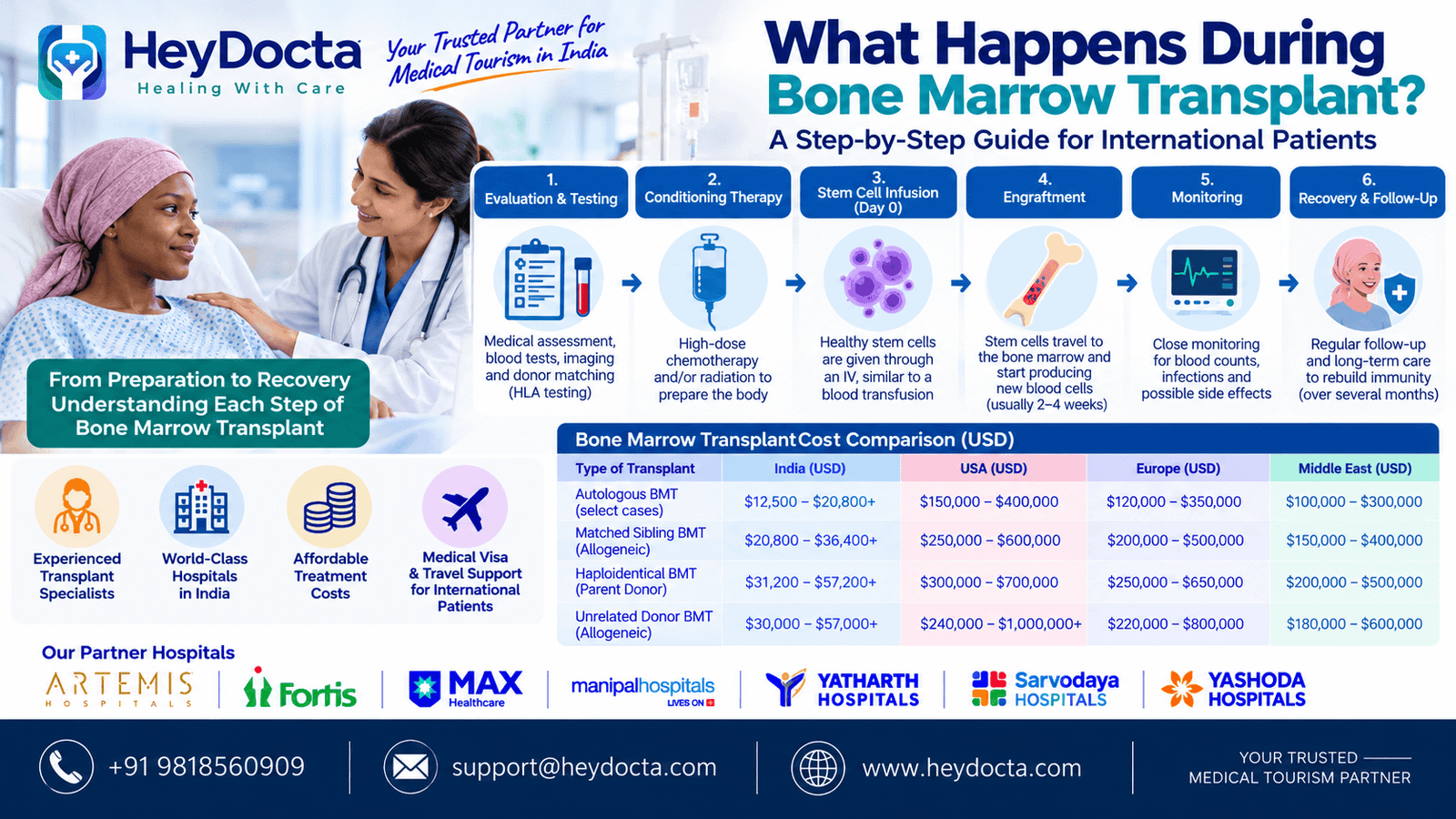
What happens during a bone marrow transplant? A bone marrow transplant, also called a hematopoietic stem cell transplant (HSCT), is a multi-step treatment in which healthy blood-forming stem cells are given to a patient after intensive preparation. The process usually includes medical evaluation, donor testing when required, conditioning treatment, stem cell infusion, engraftment and close monitoring. The National Cancer Institute notes that the overall transplant process can take several months, with recovery and immune-system rebuilding continuing well beyond the initial hospital stay.
For international patients from Nigeria, Ghana, Kenya, Cameroon, Zimbabwe, Guyana, Jamaica, the Middle East, Europe and the USA, understanding each stage can make treatment planning easier. HeyDocta helps coordinate medical opinions, hospital communication, treatment estimates, medical visa assistance, travel and follow-up support in India.
Get a Free Medical Opinion: Share the patient’s medical reports with HeyDocta to understand potential transplant options and estimated treatment costs from suitable Indian hospitals.
What Is a Bone Marrow Transplant?
A bone marrow transplant replaces damaged or diseased blood-forming stem cells with healthy stem cells. Depending on the treatment plan, the stem cells may come from the patient or another person.
The two broad categories are:
- Autologous transplant: Uses the patient’s own previously collected stem cells.
- Allogeneic transplant: Uses stem cells from a donor.
Allogeneic donors can include a matched sibling, another family member such as a haploidentical parent, or a matched unrelated donor.
The type of transplant depends on the disease, treatment history, patient’s health and availability of a suitable donor.
What Happens Before a Bone Marrow Transplant?
The transplant process begins well before the actual stem cell infusion.
1. Medical Evaluation
The transplant team reviews:
- Diagnosis and disease status
- Previous chemotherapy or other treatments
- Blood tests
- Imaging and pathology reports
- Heart, lung, liver and kidney function
- Infection screening
- Overall fitness for transplantation
The purpose is to determine whether transplantation is appropriate and to identify factors that could affect treatment.
2. Donor Matching
For an allogeneic transplant, the patient undergoes HLA typing.
Potential donors may include:
- Matched siblings
- Parents or children as haploidentical donors
- Other relatives
- Matched unrelated donors
HLA compatibility is an important part of donor selection, although doctors also consider donor health, age, CMV status and other clinical factors.
What Happens During Conditioning?
One of the most important stages is conditioning therapy.
The patient receives high-dose chemotherapy and, in some treatment protocols, radiation therapy. The purpose is to prepare the body for the transplant and, depending on the disease, eliminate or suppress abnormal cells and make space in the bone marrow for the new stem cells.
The NCI reports that conditioning commonly occurs for about one to two weeks before the stem cells are administered, although the exact protocol varies.
During this stage, patients may experience side effects such as:
- Fatigue
- Nausea or vomiting
- Reduced appetite
- Mouth sores
- Hair loss
- Low blood counts
- Increased infection risk
The transplant team provides medicines and supportive care to manage these effects.
What Happens on Transplant Day?
The day the stem cells are given is often called Day 0.
The stem cells are generally administered through an intravenous catheter, similar to receiving a blood transfusion. The NCI states that the infusion itself can take approximately one to five hours depending on the circumstances.
The patient does not undergo a conventional surgical operation to receive the stem cells.
After infusion, the cells travel through the bloodstream to the bone marrow, where they begin the process of producing new blood cells.
What Is Engraftment?
Engraftment is the stage when transplanted stem cells begin producing new blood cells.
According to the NCI, engraftment usually occurs within approximately 2–4 weeks after a stem cell transplant, although timing varies between patients and transplant types.
Doctors monitor blood counts frequently to determine whether:
- White blood cells are recovering
- Red blood cells are recovering
- Platelet production is improving
- The transplanted cells are functioning
During this period, the patient’s immune system remains weak, so infection prevention and monitoring are extremely important.
What Happens After Engraftment?
Engraftment does not mean the transplant journey is finished.
Patients continue to receive:
- Blood tests
- Medicines
- Infection monitoring
- Nutritional support
- Transfusion support when needed
- Monitoring for graft-versus-host disease in allogeneic transplantation
- Assessment of organ function
- Regular specialist consultations
The immune system takes much longer to recover than blood counts. NCI notes that immune recovery can take several months after an autologous transplant and approximately one to two years after an allogeneic or syngeneic transplant.
How Long Does Bone Marrow Transplant Take?
The exact timeline differs according to the disease, transplant type and patient’s recovery.
A simplified timeline is:
| Stage | Approximate Timing |
| Initial evaluation | Before admission |
| Donor/HLA testing | Before transplant |
| Conditioning | Usually about 1–2 weeks |
| Stem cell infusion | Day 0 |
| Early engraftment | Often around 2–4 weeks |
| Hospital monitoring | Several weeks or longer |
| Early outpatient follow-up | After discharge |
| Immune recovery | Several months to 1–2 years, depending on transplant type |
These are general timelines rather than guaranteed durations. Complications can extend hospitalisation and recovery.
Bone Marrow Transplant Cost in India
Cost is one of the most important concerns for international patients.
Some Hospitals currently publishes a general bone marrow transplant cost in India of approximately USD15000 to 31000. The hospital notes that the final cost can vary depending on the hospital, location, room type and complications.
The final cost may include or separately charge for:
- Pre-transplant investigations
- HLA and donor testing
- Conditioning therapy
- Stem cell collection
- Stem cell processing
- Hospitalisation
- Medicines
- Blood products
- Infection management
- ICU care, if required
- Post-transplant monitoring
Therefore, international patients should request a detailed hospital quotation rather than relying only on a published starting range.
Bone Marrow Transplant Cost: India vs USA
The difference in transplant costs can be significant.
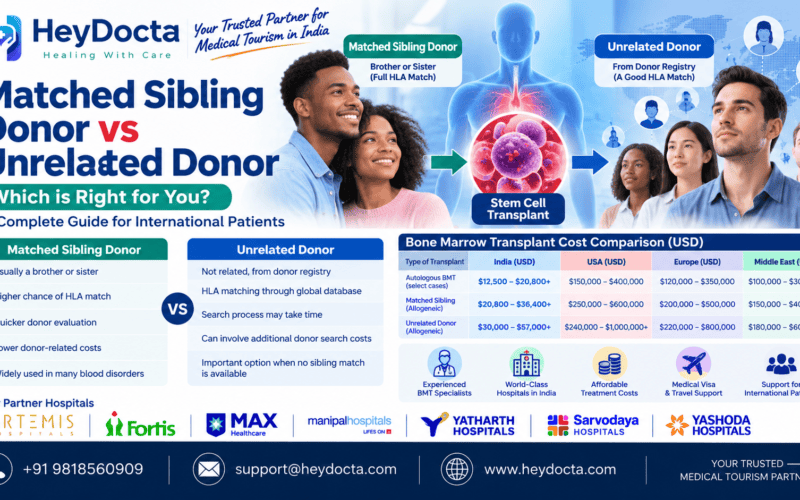
The U.S. Health Resources and Services Administration reports that an unrelated bone marrow or cord blood transplant in the United States can range from USD 240,000 to more than USD 1 million, including the transplant and up to six months of care. It also reports that donor searches can cost USD 10,000 to more than USD 50,000 in some situations.
| Cost Factor | India | USA |
| General BMT range | USD15000–31000* | — |
| Unrelated transplant | Hospital-specific | USD 240,000–USD 1 million+ |
| Donor search | Depends on centre/registry | USD 10,000–50,000+ in some cases |
| Complications | Additional | Can substantially increase total cost |
| Post-transplant care | Hospital-specific | Included in some reported U.S. ranges |
Treatment costs in Europe, the Middle East and African countries also vary according to the healthcare system, hospital, insurance and transplant type. Patients should obtain a personalised quotation before making travel arrangements.
Talk to Our Medical Tourism Expert: HeyDocta can help international patients compare treatment estimates and coordinate communication with suitable Indian transplant hospitals.
Why International Patients Consider India for Bone Marrow Transplant
Patients travelling from Africa, the Middle East, Europe, the USA and the Caribbean may consider India for complex haematology and stem cell treatment.
When comparing transplant centres, patients should look beyond price and assess:
- Experience of the transplant team
- HLA and donor coordination
- Stem cell processing facilities
- Infection-control infrastructure
- Blood bank and laboratory services
- ICU availability
- Supportive care
- Post-transplant monitoring
- Follow-up arrangements
- Total expected treatment cost
HeyDocta’s partner hospital network includes Artemis Hospitals, Fortis Hospitals, Max Hospitals, Manipal Hospital, Yatharth Hospital, Sarvodaya Hospital and Yashoda Hospital.
Bone Marrow Transplant Specialist in India
Dr. Gaurav Dixit is Head – Haematology Oncology & Bone Marrow Transplant (Unit II) at Artemis Hospitals, Gurugram. His official profile lists BMT, haematopoietic stem cell transplant, haematology and oncology among his specialties. His listed procedures include autologous stem cell transplant, matched sibling allogeneic transplant, haploidentical transplant and matched unrelated donor transplant.
Patients should select a transplant specialist based on their diagnosis, transplant requirements, donor situation and individual medical assessment.
Step-by-Step Bone Marrow Transplant Process
Step 1: Medical Consultation
The specialist reviews medical records and confirms whether transplantation should be considered.
Step 2: Testing and Donor Evaluation
The patient undergoes detailed testing. For an allogeneic transplant, potential donors undergo HLA testing and medical assessment.
Step 3: Treatment Planning
The transplant team determines the transplant type, conditioning protocol, donor strategy and supportive-care plan.
Step 4: Hospital Admission
The patient is admitted to the transplant unit and receives the necessary preparation and monitoring.
Step 5: Conditioning Therapy
Chemotherapy, with or without radiation depending on the protocol, is administered.
Step 6: Stem Cell Infusion
The collected stem cells are infused intravenously on Day 0.
Step 7: Engraftment
The new stem cells begin producing blood cells, usually within a few weeks.
Step 8: Monitoring
Doctors monitor blood counts, infections, organ function and transplant-related complications.
Step 9: Discharge and Follow-Up
Once the medical team considers the patient stable enough, discharge planning begins. Regular follow-up remains essential.
Medical Visa and Travel Support for International Patients
International patients travelling to India need appropriate medical documentation and visa arrangements.
The Government of India’s official e-Visa information requires an e-Medical Visa applicant to provide a passport bio page and a copy of the Indian hospital’s letter showing the suggested or tentative admission date.
HeyDocta can assist with:
- Medical report sharing
- Hospital coordination
- Specialist consultation
- Treatment-cost estimates
- Donor-related coordination
- Medical visa guidance
- Airport and local travel arrangements
- Accommodation coordination
- Follow-up communication
HeyDocta provides medical tourism facilitation without adding a separate service fee to the patient’s hospital treatment cost.
Recovery After Bone Marrow Transplant
Recovery is gradual.
Patients may need to stay close to the transplant hospital after discharge because frequent blood tests, consultations and medication adjustments may be necessary.
For international patients, the total India stay should account for:
- Hospitalisation
- Early recovery
- Follow-up consultations
- Blood tests
- Medicines
- Accommodation after discharge
- Emergency access if required
NCI notes that patients travelling for transplantation may also need to budget for housing and transportation outside the hospital.
The treating transplant team should provide the patient’s expected hospital and local-stay requirements.
FAQs About Bone Marrow Transplant
1. Is bone marrow transplant a surgery?
Not usually in the traditional sense. The stem cells are generally infused through an IV catheter, similar to a blood transfusion.
2. What happens on Day 0?
Day 0 is commonly the day the donor or patient’s collected stem cells are infused into the bloodstream.
3. How long does engraftment take?
Engraftment commonly occurs within approximately 2–4 weeks, although individual recovery varies.
4. How long does a bone marrow transplant take?
The overall process can take several months, including preparation, transplant, early recovery and follow-up.
5. How much does BMT cost in India?
Some Hospitals currently publishes a general range of approximately USD15000–31000 but the final cost depends on the transplant type, hospital, disease and complications.
6. Can international patients receive BMT in India?
Yes. International patients can seek treatment at Indian transplant centres, subject to medical assessment, hospital acceptance and applicable visa requirements.
7. Can HeyDocta help with the transplant journey?
Yes. HeyDocta can coordinate medical opinions, hospital communication, treatment estimates, donor-related coordination, medical visa guidance, travel and follow-up support.
Conclusion
Understanding what happens during a bone marrow transplant can help patients and families prepare for each stage, from initial evaluation and donor matching through conditioning, stem cell infusion, engraftment and long-term follow-up.
The treatment is complex and the exact process varies according to the patient’s disease, transplant type, donor availability and response to treatment. For international patients, treatment cost is also an important consideration. Published figures show a general Indian BMT range of USD15000–31000 while U.S. unrelated donor transplant costs can be substantially higher.
Get Treatment Cost from Indian Hospitals: Contact HeyDocta.com for medical report review, specialist consultation, hospital coordination, donor-related support, treatment-cost estimates, medical visa assistance, travel arrangements and end-to-end support for bone marrow transplantation in India.