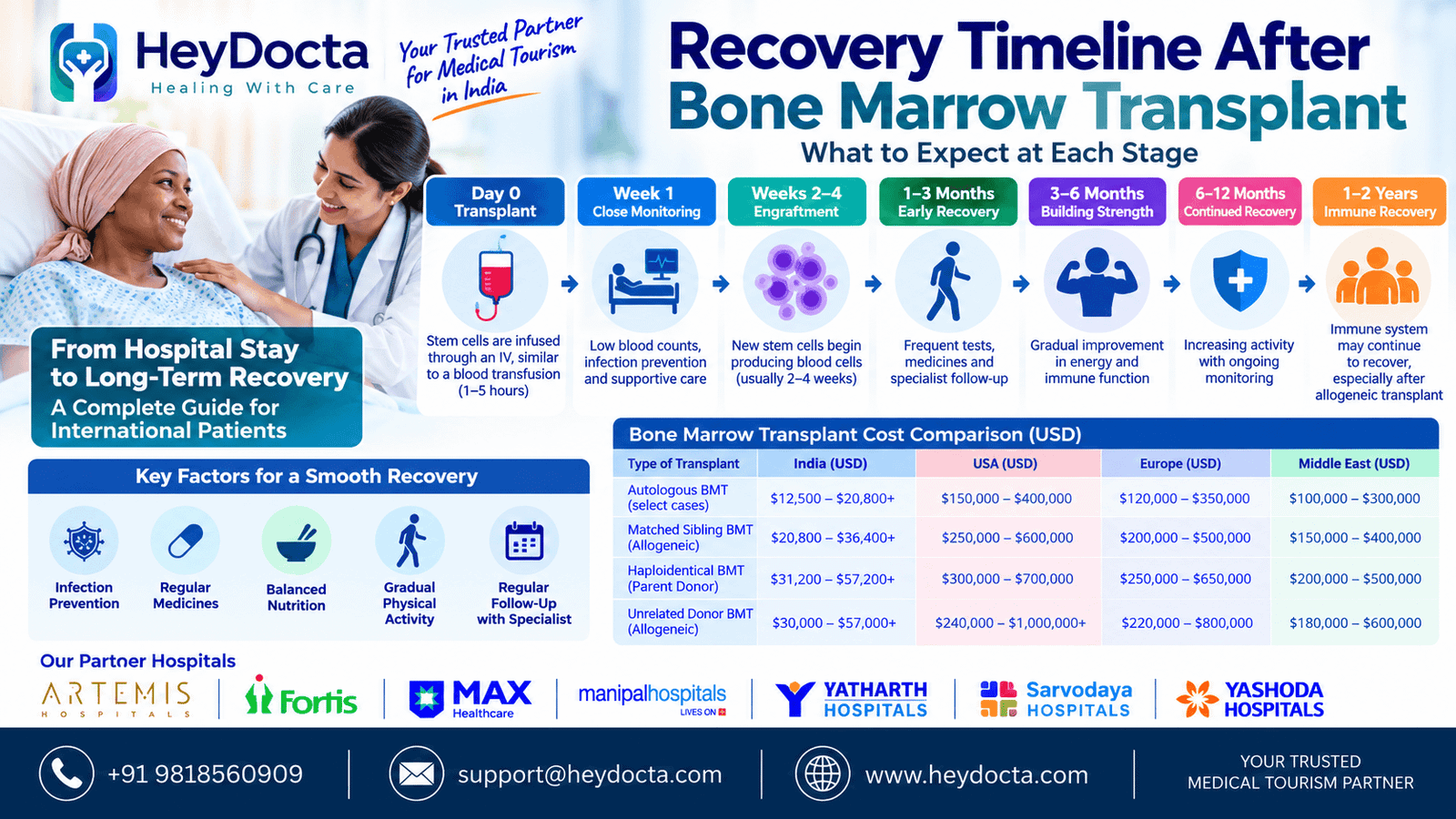
The recovery timeline after bone marrow transplant varies from patient to patient. Some patients begin returning to normal activities within a few months, while complete immune-system recovery can take much longer, particularly after an allogeneic transplant. The National Cancer Institute notes that immune recovery may take several months after an autologous transplant and around 1–2 years after an allogeneic transplant.
For international patients travelling from Nigeria, Ghana, Kenya, Cameroon, Zimbabwe, Guyana, Jamaica, the Middle East, Europe and the USA, understanding the recovery timeline is important for planning hospital stay, accommodation, flights, caregiver support and treatment costs.
HeyDocta helps international patients coordinate medical opinions, Indian hospitals, treatment estimates, medical visa guidance, travel arrangements and post-treatment communication.
Get a Free Medical Opinion: Share your medical reports with HeyDocta to understand the expected transplant pathway, recovery requirements and estimated treatment cost in India.
What Happens After a Bone Marrow Transplant?
A bone marrow transplant, also called a hematopoietic stem cell transplant (HSCT), does not end when the stem cells are infused.
The recovery phase begins after transplantation and involves:
- Engraftment of the transplanted stem cells
- Blood-count recovery
- Infection prevention and monitoring
- Management of transplant-related side effects
- Monitoring for graft-versus-host disease (GVHD) after an allogeneic transplant
- Nutritional and physical recovery
- Regular blood tests and specialist appointments
- Gradual rebuilding of the immune system
The NHS states that complete recovery can take up to a year, while the exact duration varies according to the transplant and individual patient.
Bone Marrow Transplant Recovery Timeline
Every patient follows a different recovery pathway, but the following timeline provides a general framework.
| Recovery Stage | Typical Period | What Happens |
| Day 0 | Transplant day | Stem cells are infused |
| First 1–2 weeks | Early recovery | Low blood counts, infection monitoring and supportive treatment |
| Weeks 2–4 | Engraftment | New stem cells begin producing blood cells |
| 1–3 months | Early recovery | Frequent tests, medicines and specialist follow-up |
| 3–6 months | Intermediate recovery | Gradual improvement in strength and immune function |
| 6–12 months | Continued recovery | Increasing activity with ongoing monitoring |
| 1–2 years | Longer-term recovery | Immune recovery may continue, especially after allogeneic transplant |
These are general timeframes, not fixed milestones. Infection, GVHD, graft failure, relapse, organ complications and other factors can significantly change recovery.
Day 0: The Transplant
Day 0 is commonly the day when the stem cells are infused.
The procedure usually does not involve conventional surgery. Stem cells are administered through an intravenous catheter, similar to a blood transfusion. The NCI notes that the infusion can take approximately 1–5 hours, depending on the circumstances.
After the infusion, the transplant team begins monitoring the patient’s blood counts and overall condition.
Week 1: Close Monitoring
The first week is usually a period of intensive monitoring.
The patient’s blood counts may be very low because of the conditioning treatment given before transplantation.
Doctors and nurses monitor:
- White blood cell counts
- Platelets
- Red blood cells
- Temperature and signs of infection
- Kidney and liver function
- Fluid balance
- Nutrition
- Possible medication side effects
Patients may require blood or platelet transfusions during this period.
Infection prevention is especially important because the immune system is weakened.
Weeks 2–4: Engraftment
One of the most important recovery milestones is engraftment.
This occurs when the transplanted stem cells begin producing new blood cells.
The NCI describes stem-cell engraftment as generally occurring within approximately 2–4 weeks, although the timing can vary.
Doctors regularly check blood counts to determine whether:
- White blood cells are increasing
- Platelets are recovering
- Red blood cell production is improving
- The new stem cells are functioning
Successful engraftment does not mean that the patient’s immune system has fully recovered.
First 1–3 Months After Transplant
The first three months are often an important period of continued medical supervision.
Patients may still experience:
- Fatigue
- Reduced appetite
- Weakness
- Infection risk
- Weight changes
- Digestive problems
- Skin changes
- Medication side effects
For allogeneic transplant patients, doctors also monitor for graft-versus-host disease (GVHD).
GVHD occurs when donor immune cells recognise the patient’s tissues as foreign. It can be acute or chronic and can affect organs including the skin, liver and gastrointestinal tract.
Follow-up appointments may initially be frequent. The NHS notes that after discharge, check-ups are often weekly at first.
3–6 Months After Bone Marrow Transplant
Many patients gradually become more active during this period, but recovery is still ongoing.
The medical team may continue monitoring:
- Blood counts
- Infection markers
- Liver and kidney function
- Medication levels
- GVHD
- Nutrition
- Weight
- Physical strength
Patients may gradually increase physical activity according to their doctor’s advice.
Short walks can be useful during recovery, but the appropriate level of exercise depends on the patient’s condition.
The NHS recommends gradually increasing activity and resting when needed during recovery.
6–12 Months After Transplant
Some patients experience significant improvement in energy and daily functioning during this period.
However, allogeneic transplant recipients may still require:
- Regular specialist follow-up
- Immunosuppressive medicines in selected cases
- Infection monitoring
- Vaccination planning
- Blood tests
- GVHD monitoring
The NHS states that it can take up to a year to fully recover from a stem cell or bone marrow transplant.
1–2 Years After Bone Marrow Transplant
Long-term recovery can continue well beyond the first year.
The NCI reports that immune recovery may take 1–2 years after an allogeneic or syngeneic transplant, compared with several months after an autologous transplant.
Some patients recover sooner, while others need longer follow-up because of complications or ongoing treatment.
The treating transplant team should determine when a patient can safely return to normal activities, travel, work or school.
When Can International Patients Return Home?
This is one of the most important questions for patients travelling to India.
There is no universal discharge or return-home date.
Before returning to Nigeria, Kenya, Ghana, Cameroon, Zimbabwe, Guyana, Jamaica, Europe, the Middle East or the USA, the transplant team generally needs to assess:
- Blood-count recovery
- Infection status
- Medication requirements
- GVHD or other complications
- Ability to continue follow-up
- Availability of medical care in the home country
- Need for blood or platelet transfusions
- Distance from the treating hospital
The NCI notes that patients may be able to return home around 100 days after receiving donor stem cells if there are no problems, but they still require close medical follow-up.
This should be treated as a general reference, not a travel recommendation for an individual patient.
Recovery After Autologous vs Allogeneic Transplant
Recovery can differ according to transplant type.
| Factor | Autologous BMT | Allogeneic BMT |
| Stem cells | Patient’s own | Donor |
| GVHD risk | No donor GVHD | Possible |
| Immune recovery | Generally faster | Usually longer |
| Follow-up | Intensive | Often prolonged |
| Infection risk | Significant during early recovery | Can remain significant for longer |
| Long-term immune recovery | Often several months | May take 1–2 years |
The NCI specifically notes the longer immune-recovery period associated with allogeneic transplantation.
Bone Marrow Transplant Recovery Cost in India
Recovery-related expenses are an important part of the total medical tourism budget.
The published cost of the transplant may not cover every expense during recovery.
Possible additional costs include:
- Extended hospital stay
- Additional medicines
- Blood and platelet transfusions
- Infection treatment
- Additional diagnostic tests
- GVHD treatment
- ICU treatment when required
- Accommodation after discharge
- Local transportation
- Follow-up consultations
Some Hospitals currently publishes a general bone marrow transplant cost in India of USD15000 –31000 noting that the final cost depends on hospital, location, room category and complications.
India vs USA: Cost Perspective
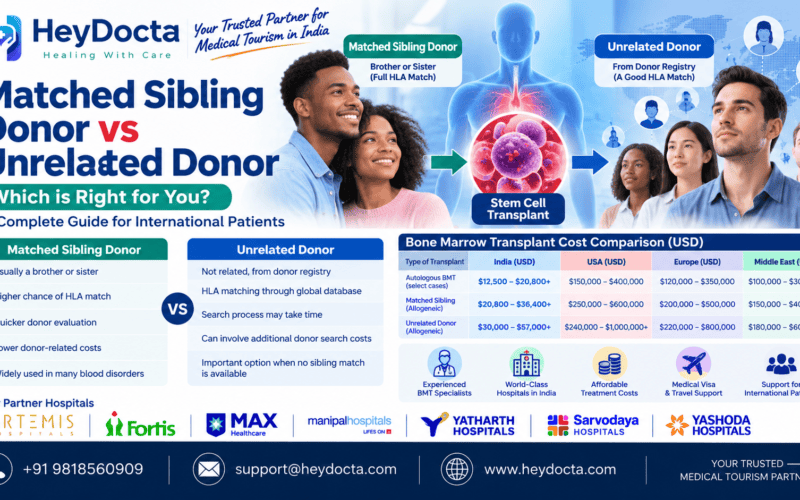
The U.S. Health Resources and Services Administration reports that an unrelated bone marrow or cord blood transplant can cost approximately USD 240,000 to more than USD 1 million, including the transplant and up to six months of care.
| Cost Consideration | India | USA |
| General BMT planning range | USD15000–31000 * | — |
| Unrelated donor transplant | Hospital-specific | USD 240,000 to >USD 1 million** |
| Extended recovery | Depends on patient | Can substantially increase total cost |
| Accommodation/travel | Additional | Additional depending on location |
| Complications | Additional | Additional |
HRSA reported range includes transplant and up to six months of care. These figures are not directly comparable hospital packages.
Costs in Europe, the Middle East and Africa also vary widely. Insurance coverage and public/private healthcare systems can make direct country-to-country comparisons difficult.
Talk to Our Medical Tourism Expert: HeyDocta can help you request a patient-specific treatment estimate from suitable Indian hospitals, including likely hospitalisation and follow-up requirements.
Why International Patients Consider India for BMT
Patients travelling internationally often compare treatment cost, transplant infrastructure and continuity of care.
For BMT, patients should evaluate:
- Transplant specialist experience
- Dedicated transplant unit
- HLA and donor coordination
- Blood bank facilities
- Infection-control measures
- Laboratory and diagnostic services
- ICU support
- Post-transplant monitoring
- Follow-up arrangements
- Total estimated treatment cost
HeyDocta’s partner hospital network includes Artemis Hospitals, Fortis Hospitals, Max Hospitals, Manipal Hospital, Yatharth Hospital, Sarvodaya Hospital and Yashoda Hospital.
Bone Marrow Transplant Specialist in India
Dr. Gaurav Dixit is Head – Haematology Oncology & Bone Marrow Transplant at Artemis Hospitals, Gurugram. His official profile lists 20 years of experience and specialties including BMT, haematopoietic stem cell transplantation, haematology and oncology. His listed procedures include autologous, matched sibling allogeneic, haploidentical and matched unrelated donor transplantation.
Patients should select a transplant team based on their diagnosis, transplant type, donor requirements and individual medical assessment.
How HeyDocta Supports International Patients During Recovery
Recovery planning is especially important when a patient travels abroad for BMT.
HeyDocta can assist with:
- Medical report coordination
- Hospital communication
- Specialist consultation
- Treatment-cost estimates
- Donor-related coordination
- Medical visa guidance
- Airport assistance
- Accommodation coordination
- Local travel arrangements
- Follow-up communication
India’s official e-Visa information requires an e-Medical Visa applicant to provide a passport bio page and a letter from the Indian hospital containing the suggested or tentative admission/treatment date.
HeyDocta provides this medical-tourism facilitation without adding a separate service fee to the patient’s hospital treatment cost.
Diet, Activity and Infection Prevention During Recovery
Recovery instructions must come from the treating transplant team because nutritional and activity requirements vary.
General recovery guidance may include:
- Follow prescribed medicines carefully
- Maintain hand hygiene
- Follow the hospital’s food-safety instructions
- Avoid exposure to people with infections
- Increase physical activity gradually
- Rest when fatigued
- Attend scheduled blood tests
- Report fever or new symptoms promptly
- Follow vaccination recommendations from the transplant team
The NHS recommends careful food hygiene, regular handwashing and gradually increasing activity during recovery.
FAQs About Bone Marrow Transplant Recovery
1. How long does it take to recover from a bone marrow transplant?
Many patients need several months to recover, and complete recovery can take up to a year. Immune recovery after an allogeneic transplant can take 1–2 years.
2. How long does engraftment take?
Engraftment commonly occurs around 2–4 weeks after transplant, although the timing varies between patients.
3. When can I return home after BMT in India?
The timing depends on blood-count recovery, infections, complications and the transplant team’s assessment. International patients should not book a return flight until their treating team confirms that travel is appropriate.
4. How long should international patients stay in India?
The required stay varies. Patients may need several weeks of hospital care followed by additional time near the transplant centre for follow-up.
5. Is recovery faster after an autologous transplant?
Immune recovery is generally shorter after an autologous transplant than after an allogeneic transplant, but individual recovery varies.
6. What is the cost of bone marrow transplant in India?
A general published BMT range from Some Hospitals is USD15000–31000. Actual costs depend on transplant type, hospital, disease and complications.
7. Can HeyDocta help after the transplant?
Yes. HeyDocta can help coordinate hospital follow-up, local arrangements and communication with the treating centre for international patients.
Conclusion
The recovery timeline after bone marrow transplant is gradual and differs from one patient to another. The first few weeks focus on engraftment and infection prevention, while the following months focus on rebuilding strength, monitoring complications and restoring immune function.
Autologous transplant patients may recover their immune function sooner, while allogeneic transplant patients can require significantly longer monitoring. The NCI reports that immune recovery after an allogeneic transplant can take 1–2 years.
For international patients, recovery planning should include not only medical care but also accommodation, travel, caregiver support and follow-up costs. India offers specialised transplant centres, while published BMT costs are generally much lower than the large U.S. costs reported for some unrelated donor transplant pathways.
Get Treatment Cost from Indian Hospitals: Contact HeyDocta.com for medical report review, specialist consultation, hospital coordination, treatment-cost estimates, medical visa guidance, accommodation and travel assistance, and continued support throughout your bone marrow transplant journey in India.