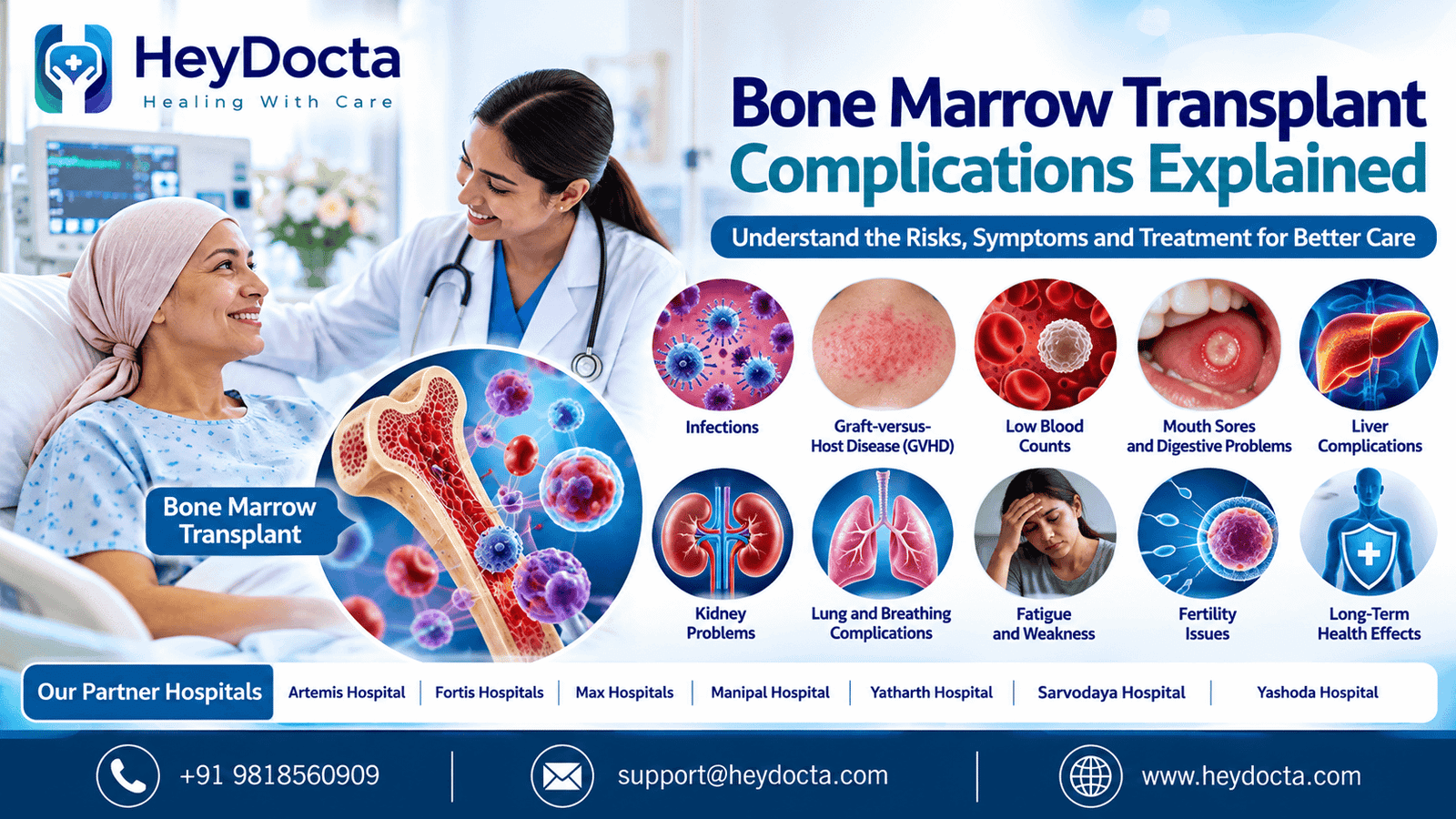
Bone marrow transplant complications can occur during the early recovery period or months and years after transplantation. Patients may experience infections, low blood counts, graft-versus-host disease (GVHD), organ-related problems, medication side effects and other complications. The type and severity depend on the transplant type, underlying disease, conditioning treatment, donor match and overall health.
For international patients considering bone marrow transplant in India, understanding potential complications is an important part of treatment planning. Patients should discuss their individual risks, monitoring requirements, expected hospital stay and possible additional costs with their transplant specialist.
Get a Free Medical Opinion: Share your reports with HeyDocta to understand potential treatment options and whether a transplant evaluation in India may be appropriate.
What Is a Bone Marrow Transplant?
A bone marrow transplant, also called a hematopoietic stem cell transplant (HSCT), replaces damaged or diseased blood-forming stem cells with healthy stem cells.
Depending on the patient’s condition, doctors may recommend:
- Autologous transplant: the patient’s own stem cells are collected and returned.
- Allogeneic transplant: stem cells come from a donor.
- Matched sibling transplant: a compatible sibling provides the stem cells.
- Haploidentical transplant: a partially matched family member serves as the donor.
- Matched unrelated donor transplant: stem cells come from a compatible unrelated donor.
Allogeneic transplantation has additional complications such as GVHD because donor immune cells can attack the recipient’s tissues.
Why Do Bone Marrow Transplant Complications Occur?
BMT involves intensive treatment, often including chemotherapy and sometimes radiation, followed by stem cell infusion and a period of immune-system recovery.
During this process, patients can experience:
- Very low blood cell counts
- Weakened immunity
- Tissue damage from conditioning treatment
- Medication side effects
- Donor immune reactions
- Organ stress
- Nutritional problems
NCI notes that stem cell transplantation can cause both short-term and long-term complications, including infections, nausea, vomiting, fatigue, mouth sores, skin reactions, infertility, cataracts, secondary cancers and damage involving the liver, kidneys, lungs or heart.
Common Bone Marrow Transplant Complications
1. Infections
Infection is one of the major concerns following BMT because immune recovery takes time.
Bacterial infections are particularly common during the early neutropenic period. Viral and fungal infections can also occur, especially when immune suppression continues for a longer period. Preventive antibiotics, antivirals or antifungal medicines may be used according to the patient’s risk profile.
Possible warning signs include:
- Fever or chills
- Cough
- Breathing difficulty
- Persistent diarrhea
- Burning during urination
- New skin changes
- Severe weakness
Any suspected infection after transplant requires prompt medical evaluation.
2. Graft-Versus-Host Disease
GVHD mainly occurs after an allogeneic transplant. Donor immune cells may recognise the recipient’s tissues as foreign and attack them.
GVHD can affect the:
- Skin
- Liver
- Intestines
- Eyes
- Mouth
- Lungs
- Joints and muscles
- Other organs
Acute GVHD often involves skin rash, diarrhea or liver abnormalities, while chronic GVHD may affect multiple organs and cause longer-term problems.
3. Low Blood Counts
After conditioning treatment, patients can experience low levels of:
- Red blood cells
- White blood cells
- Platelets
This can increase the risk of anemia, infection and bleeding. Patients may require blood or platelet transfusions until the transplanted stem cells begin producing adequate blood cells.
4. Mucositis and Digestive Problems
Chemotherapy and conditioning treatment can damage the lining of the mouth and digestive tract.
Symptoms may include:
- Mouth ulcers
- Pain while eating
- Difficulty swallowing
- Nausea
- Vomiting
- Diarrhea
- Loss of appetite
Nutrition and hydration support can become an important part of recovery.
5. Liver Complications
The liver can be affected by medications, infections, conditioning treatment or transplant-related complications.
One important early complication is sinusoidal obstruction syndrome (SOS), also called veno-occlusive disease (VOD). It can involve liver enlargement, abdominal discomfort, fluid retention and increased bilirubin. Severe cases can affect multiple organs.
6. Kidney Problems
Kidney function may be affected by certain medicines, infections, dehydration, high blood pressure and transplant-related conditions.
Doctors may regularly monitor:
- Creatinine
- Electrolytes
- Urine
- Blood pressure
- Overall kidney function
Long-term kidney problems can occur in some transplant survivors.
7. Lung and Breathing Complications
Some patients can develop lung complications after HSCT.
Possible symptoms include:
- Persistent cough
- Shortness of breath
- Reduced exercise tolerance
- Low oxygen levels
Because infections can cause similar symptoms, new breathing problems should be assessed promptly.
8. Fatigue and Weakness
Fatigue can continue after hospital discharge. Possible contributing factors include anemia, medications, infections, nutritional deficiencies, poor sleep and the body’s ongoing recovery.
Gradual physical activity and rehabilitation may be recommended according to the patient’s condition.
9. Fertility Problems
Some conditioning treatments can affect reproductive function and fertility.
NCI identifies infertility as a potential long-term complication of stem cell transplantation. Patients who may want children in the future should discuss fertility preservation options with their medical team before treatment whenever possible.
10. Late Effects
Some complications can appear months or years after transplant.
These may include:
- Cataracts
- Hormonal problems
- Fertility problems
- Bone and muscle weakness
- Chronic GVHD
- Kidney, liver, lung or heart problems
- Secondary cancers
The risk depends on previous treatment, transplant type, age and other individual factors.
Early vs Long-Term BMT Complications
| Complication | Early After BMT | Long-Term Possibility |
| Infection | Common concern | Possible with prolonged immune suppression |
| Low blood counts | Common | Usually improves with engraftment |
| Mouth sores | Common | Usually temporary |
| Nausea/vomiting | Common | Usually improves |
| GVHD | Possible | Chronic GVHD can persist |
| Liver problems | Possible | Can require continued monitoring |
| Kidney problems | Possible | Chronic kidney disease can occur |
| Fertility problems | Usually treatment-related | May be long-term |
| Cataracts | Less common early | Possible late effect |
| Secondary cancers | Rare early | Possible late effect |
How Are BMT Complications Monitored?
Close monitoring is an important part of transplant care.
Doctors may regularly perform:
- Complete blood counts
- Kidney and liver-function tests
- Infection screening
- Viral PCR monitoring when indicated
- Medication-level monitoring
- Imaging when clinically necessary
- GVHD assessments
- Nutritional evaluation
- Lung or heart assessments when required
- Long-term follow-up examinations
NCI notes that immune recovery may take approximately 3–9 months after autologous HSCT and 9–24 months after allogeneic HSCT without GVHD, although recovery varies between individuals. Patients with active chronic GVHD may remain immunosuppressed for much longer.
Treatment of Bone Marrow Transplant Complications
Treatment depends entirely on the specific complication.
For example:
- Infections: antimicrobial treatment and preventive medicines
- GVHD: corticosteroids and other immunosuppressive therapies when appropriate
- Low blood counts: transfusions and supportive care
- Nutritional problems: dietitian support and nutritional supplementation
- Kidney problems: medication adjustment, fluids or specialist care
- Lung complications: investigations and targeted treatment
- Organ complications: specialist management and supportive therapy
Treatment must be personalised because medicines used to control complications can themselves have side effects.
Bone Marrow Transplant Complications in India
India has specialised hematology and BMT centres that provide transplant care and monitoring for complications.
HeyDocta’s partner hospital network includes:
- Artemis Hospital
- Fortis Hospitals
- Max Hospitals
- Manipal Hospital
- Yatharth Hospital
- Sarvodaya Hospital
- Yashoda Hospital
At Artemis Hospitals, Dr. Gaurav Dixit is listed as Head – Haematology Oncology & Bone Marrow Transplant . His listed specialties include BMT, hematopoietic stem cell transplantation, hematology, oncology and paediatric haemato-oncology & BMT. His listed procedures include autologous, matched sibling allogeneic, haploidentical and matched unrelated donor transplantation.
Artemis also describes dedicated BMT infrastructure with infection-control policies, positive-pressure and HEPA-filtered rooms.
Talk to HeyDocta for a medical opinion and assistance coordinating BMT treatment in India.
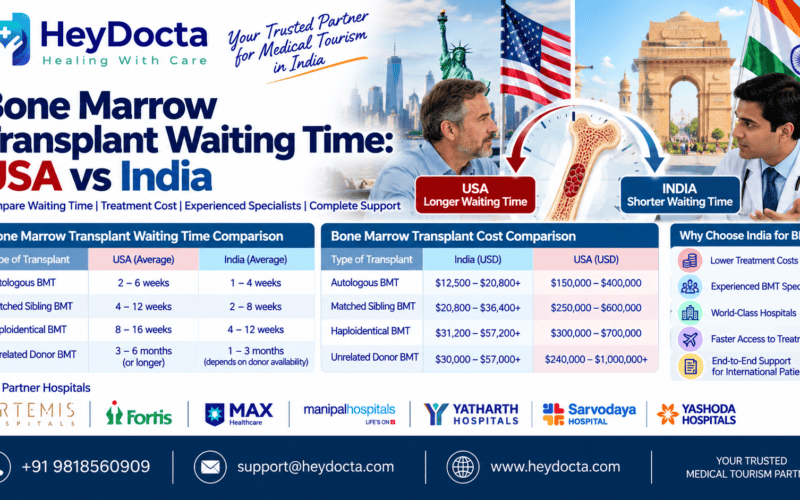
Bone Marrow Transplant Cost in India vs Other Countries
Complications can have a significant effect on the final cost of BMT because additional hospitalisation, medicines, investigations, blood products and specialist care may be required.
Some Hospitals currently publishes a general BMT cost range of approximately USD15000 to 31000 in India, while noting that the actual cost varies according to hospital, location, room type and complications.
NCI notes that stem cell transplantation is a complex treatment that can involve long hospital stays and multiple healthcare professionals.
| Cost Component | India | Other Countries |
| BMT procedure | Approximately USD15000–31000* | Varies significantly |
| Hospitalisation | Depends on recovery | Can be substantial |
| Medicines | Depends on treatment | May add considerably |
| Complication management | Patient-specific | Patient-specific |
| Follow-up | Patient-specific | Patient-specific |
| Final cost | Individual quotation | Individual quotation |
Indicative published Indian range, not a guaranteed package price. The final quotation depends on transplant type, donor, medicines, hospital stay and complications.
For international patients from Nigeria, Ghana, Kenya, Zimbabwe, Cameroon, Guyana, Jamaica, Europe, the Middle East and the USA, comparing the total treatment journey is more useful than comparing only the procedure price.
Get a personalised BMT cost estimate and medical opinion through HeyDocta.
Step-by-Step BMT Complication Management
Step 1: Pre-Transplant Assessment
Doctors review the patient’s disease, organ function, infection history and previous treatments.
Step 2: Conditioning
The patient receives the prescribed conditioning regimen before stem cell infusion.
Step 3: Stem Cell Infusion
The donor or patient’s stored stem cells are infused according to the transplant plan.
Step 4: Engraftment Monitoring
Blood counts, infections, organ function and medication effects are closely monitored.
Step 5: Early Complication Management
Any infection, GVHD, bleeding, organ problem or other complication is evaluated and treated promptly.
Step 6: Discharge Planning
The patient receives instructions regarding medicines, food safety, hygiene, warning signs and follow-up.
Step 7: Long-Term Follow-Up
Follow-up continues after returning home and may involve coordination between the Indian transplant team and the patient’s local healthcare providers.
Medical Visa and Travel Support
International patients travelling to India for BMT require appropriate medical documentation and travel arrangements.
HeyDocta can support patients with:
- Medical opinion coordination
- Hospital appointment scheduling
- Treatment-cost coordination
- Medical visa documentation support
- Travel planning
- Accommodation coordination
- Airport assistance
- Follow-up coordination
HeyDocta acts as a medical tourism facilitator and does not replace the treating hospital or doctor. HeyDocta does not add a separate service fee to the patient’s hospital treatment cost.
FAQs About Bone Marrow Transplant Complications
1. What are the most common complications of bone marrow transplant?
Important complications include infections, low blood counts, GVHD after allogeneic transplant, nausea, mouth sores, fatigue, organ complications and medication side effects.
2. Is GVHD possible after every bone marrow transplant?
Classic GVHD is associated with an allogeneic transplant because donor immune cells can attack the recipient’s tissues. It is not the typical complication of an autologous transplant using the patient’s own cells.
3. How long does the risk of complications last after BMT?
The risk changes over time. Some complications occur mainly during the first weeks or months, while chronic GVHD and certain late effects can occur much later.
4. Can BMT complications be treated?
Many complications can be managed with medicines, supportive care, monitoring and specialist treatment. The approach depends on the specific complication and its severity.
5. How much does BMT cost in India?
Some Hospitals currently publishes an indicative range of approximately USD 15000–31000, but individual costs vary according to transplant type, hospital, room category, medicines and complications.
6. When should a BMT patient contact the doctor?
Patients should promptly report fever, breathing difficulty, severe diarrhea, unusual bleeding, new rash, jaundice, persistent vomiting or other sudden or worsening symptoms.
7. Can international patients receive BMT complication care in India?
Yes. Patients can seek evaluation and treatment at specialised hematology and BMT centres in India. Their medical records, transplant history and current treatment should be reviewed before travel whenever possible.
Conclusion
Bone marrow transplant complications are an important part of treatment planning, but their risk and severity vary considerably from one patient to another. Infection, GVHD, low blood counts, digestive problems, organ complications, fertility issues and late effects may require different forms of monitoring and treatment.
For international patients, the overall treatment plan should consider not only the initial BMT cost but also possible hospitalisation, medicines, complication management, follow-up and travel requirements. India offers specialised transplant centres, but patients should receive an individual medical assessment and cost estimate before making treatment arrangements.
HeyDocta helps international patients coordinate medical opinions, hospital appointments, treatment-cost information, medical visa support, travel arrangements and follow-up care in India.
Get Treatment Cost from Indian Hospitals: Share your medical reports with HeyDocta.com to discuss suitable treatment options, transplant evaluation and estimated treatment costs in India.