
Choosing the right hospital for a bone marrow transplant in India is one of the most important decisions for an international patient. BMT, also called hematopoietic stem cell transplantation (HSCT), can involve intensive treatment, prolonged hospitalisation, donor matching and months of follow-up care. The hospital you select can therefore affect not only your treatment experience but also your overall medical travel budget.
For patients travelling from Nigeria, Ghana, Kenya, Zimbabwe, Cameroon, Guyana, Jamaica, the Middle East, Europe and the USA, comparing hospitals only by the quoted transplant price is not enough. You should ask detailed questions about the transplant team, infection-control facilities, donor matching, medicines, hospital stay, complications, follow-up and total expected cost.
Get free medical opinion: HeyDocta can help you compare suitable partner hospitals, request medical opinions and understand the estimated treatment cost before travelling.
Why Choosing the Right BMT Hospital Matters
A bone marrow transplant is not simply a single procedure. Depending on the patient’s condition and transplant type, treatment may involve pre-transplant evaluation, conditioning therapy, stem-cell collection or donor preparation, transplantation, monitoring and post-transplant care. Donor matching is also an important consideration for allogeneic transplantation.
Recovery can take months, and some patients require several weeks of hospital care followed by frequent monitoring. The NHS notes that full recovery can take up to a year in some patients.
This makes hospital selection especially important for international patients who must also plan accommodation, flights, visas and the stay of an accompanying family member.
10 Important Questions to Ask Before Choosing a Bone Marrow Transplant Hospital
1. How experienced is the hospital’s BMT team?
Ask:
- How many years has the hospital been performing BMTs?
- Does it have dedicated hematologists and transplant specialists?
- Does the team manage both adult and paediatric patients?
- Does the hospital provide multidisciplinary support?
Look beyond general hospital experience. BMT requires specialised hematology, oncology, transplant nursing, laboratory and critical-care support.
2. Which types of bone marrow transplant does the hospital perform?
Ask whether the centre performs:
- Autologous stem cell transplant
- Matched sibling allogeneic transplant
- Haploidentical transplant
- Matched unrelated donor transplant
- Other appropriate cellular therapies
The appropriate transplant depends on the disease, previous treatment, patient’s health and donor availability.
For example, Dr. Gaurav Dixit, Head – Haematology Oncology & Bone Marrow Transplant at Artemis Hospitals, Gurugram, specialises in BMT, hematopoietic stem cell transplantation, hematology and oncology. His listed transplant procedures include autologous, matched sibling allogeneic, haploidentical and matched unrelated donor transplantation.
3. Does the hospital have dedicated infection-control facilities?
This is one of the most important questions.
Ask about:
- HEPA-filtered rooms
- Positive-pressure or specialised transplant rooms
- Infection-control protocols
- Isolation facilities
- Microbiology and laboratory support
- Availability of intensive care
After conditioning therapy, patients can have severely weakened immunity and an increased infection risk. Special room arrangements and infection-control procedures may therefore be important during the transplant period.
4. How is donor matching handled?
For allogeneic transplantation, ask:
- Is HLA testing available?
- Can family members be tested?
- Does the hospital coordinate unrelated donor searches?
- What happens if a matched sibling is unavailable?
- Is haploidentical transplantation available when clinically appropriate?
HLA matching helps doctors assess compatibility between donor and recipient. A closer match can reduce certain transplant-related risks.
5. What is included in the BMT treatment cost?
Never accept a transplant quote without asking for a written cost breakdown.
Ask whether the estimate includes:
- Pre-transplant investigations
- HLA testing
- Donor testing
- Conditioning therapy
- Stem-cell collection
- Transplant procedure
- Hospital room
- Medicines
- Blood and platelet transfusions
- ICU care, if required
- Doctor and nursing charges
- Post-transplant monitoring
- Follow-up consultations
This is particularly important because the lowest initial quote may not always represent the lowest total treatment cost.
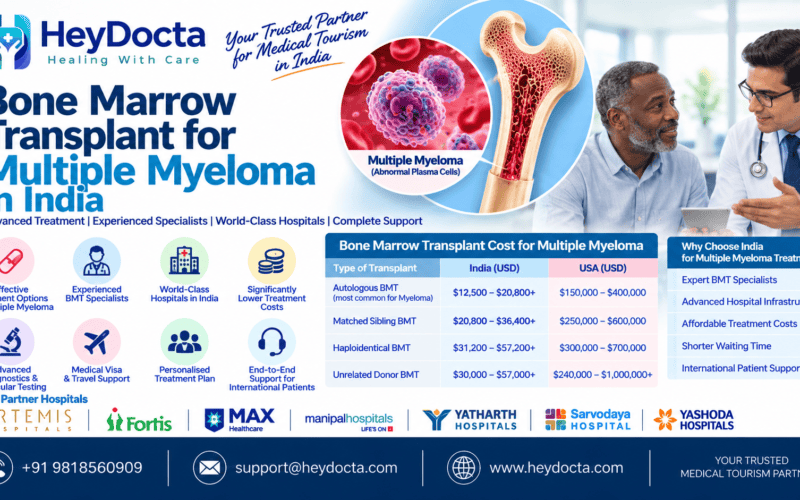
Bone Marrow Transplant Cost: India vs Other Countries
Cost is a major reason international patients consider India, but prices should always be compared on a like-for-like basis.
| Country/Region | Indicative BMT Cost | Important Consideration |
| India | USD15000–31000 in a commonly cited range | Varies by transplant type, hospital, stay and complications |
| USA | US$240,000 to over US$1 million for an unrelated transplant plus up to 6 months of care | Insurance and donor-search costs can affect the final amount |
| UK/Europe | Varies significantly | Public/private systems, eligibility and treatment pathway affect cost |
For comparison, the U.S. Health Resources and Services Administration states that an unrelated bone marrow or cord-blood transplant can cost US$240,000 to more than US$1 million, including the transplant and up to six months of care. Donor-search costs may be additional.
The important lesson is simple: compare the complete treatment package, not just the transplant procedure price.
6. What happens if complications occur?
Ask:
- Is 24/7 critical care available?
- Is an ICU available within the hospital?
- Are infectious disease specialists available?
- Can the hospital manage GVHD?
- Is blood and platelet support available?
- Can emergency procedures be performed immediately?
BMT can have complications including infections, bleeding, fatigue, gastrointestinal symptoms and, in donor transplants, graft-versus-host disease (GVHD).
7. How long will I need to stay in India?
Ask for two estimates:
- Expected hospital stay
- Expected total stay in India
The hospital stay can vary according to transplant type and recovery. Artemis Hospitals states that BMT patients usually remain in hospital for several weeks, depending on recovery and complications.
International patients may also need additional time in India after discharge for follow-up and medical clearance before flying home.
8. What follow-up care will I receive after discharge?
Ask:
- How frequently are follow-up appointments required?
- Will blood tests be needed?
- Who manages medicines after discharge?
- Can follow-up consultations happen online after returning home?
- What should I do if I develop fever or other symptoms after returning?
Regular monitoring is an important part of recovery, particularly during the early post-transplant period.
9. Can the hospital provide a complete treatment estimate before travel?
International patients should request a written estimate based on their medical reports.
Ask the hospital to clarify:
- Estimated treatment cost
- Expected hospital stay
- Additional investigations
- Donor-related expenses
- Medicines
- Possible additional costs
- Follow-up requirements
This helps you prepare a realistic medical travel budget.
10. Does the hospital support international patients?
Ask whether the hospital provides:
- Medical invitation letters
- Visa assistance
- Airport transfers
- Accommodation support
- Language interpretation
- International patient coordinators
- Assistance for attendants
- Post-discharge travel coordination
For example, Artemis Hospitals lists international patient services including tele-consultation, visa services, hotel booking, airport pickup/drop and post-discharge travel assistance.
BMT Hospitals International Patients May Consider in India
Patients can compare BMT services at established hospitals based on medical suitability, transplant expertise, infrastructure, cost transparency and international-patient support.
HeyDocta’s partner hospitals include:
- Artemis Hospital
- Fortis Hospitals
- Max Hospitals
- Manipal Hospital
- Yatharth Hospital
- Sarvodaya Hospital
- Yashoda Hospital
The objective should not simply be to identify the “best” hospital. Instead, choose the centre whose transplant team, facilities and treatment plan are appropriate for your individual medical condition.
Need help comparing hospitals? HeyDocta can coordinate medical reports with suitable partner hospitals and help international patients understand treatment options and estimated costs without adding a separate HeyDocta service fee to the patient’s hospital treatment cost.
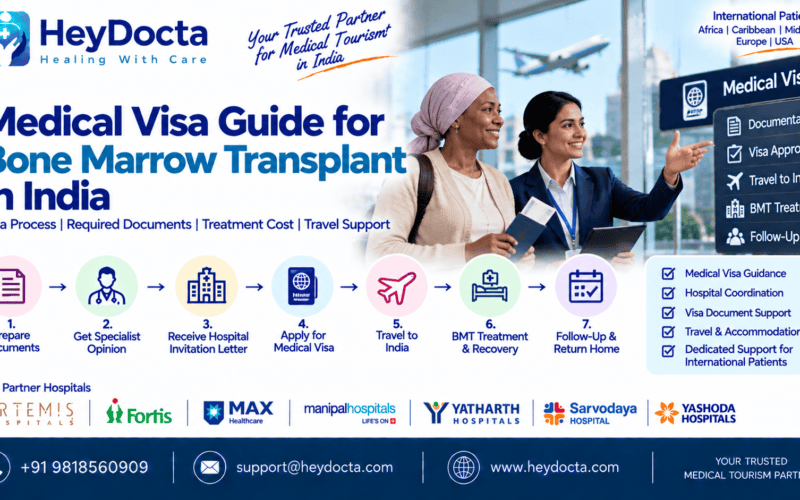
Step-by-Step Process for International BMT Patients
Step 1: Share medical records
Send pathology reports, bone marrow biopsy reports, imaging, previous treatment details and other relevant medical records.
Step 2: Get a specialist opinion
A BMT specialist evaluates the diagnosis, disease status, previous treatment and transplant suitability.
Step 3: Compare treatment plans
Compare recommended transplant type, hospital stay, estimated cost, donor requirements and follow-up plan.
Step 4: Plan your medical trip
After selecting the hospital, arrange the medical invitation, visa, flights, accommodation and attendant requirements.
Step 5: Complete pre-transplant evaluation
Before transplantation, patients generally undergo tests to assess their overall health and organ function.
Step 6: Begin transplant treatment
Treatment may include conditioning therapy followed by stem-cell infusion. The exact protocol depends on the patient’s transplant type and medical condition.
Step 7: Recovery and monitoring
Patients remain under close medical supervision during the early recovery period, followed by regular follow-up after discharge.
Medical Visa and Travel Support for International Patients
International patients should plan their visa and travel arrangements only after receiving a treatment plan and hospital documentation.
HeyDocta can assist with the medical tourism process, including:
- Hospital coordination
- Medical opinion
- Treatment-cost estimates
- Medical visa guidance
- Travel planning
- Accommodation coordination
- Airport assistance
- Follow-up coordination
Patients should always follow the treating hospital’s advice regarding when it is medically safe to travel after transplantation.
FAQs
1. What should I ask a bone marrow transplant hospital before choosing it?
Ask about BMT experience, transplant types, donor matching, infection control, ICU facilities, treatment cost, medicines, hospital stay, complications and post-transplant follow-up.
2. How much does bone marrow transplant cost in India?
A commonly cited Indian range is around USD15000–31000, but the final cost depends on transplant type, hospital, patient condition, length of stay and complications.
3. Is BMT cheaper in India than in the USA?
India can be substantially less expensive. U.S. HRSA information indicates that an unrelated transplant can cost US$240,000 to over US$1 million including up to six months of care.
4. How long should international patients stay in India after BMT?
The hospital stay may last several weeks, while the total stay in India depends on recovery, complications and follow-up requirements.
5. Can international patients get BMT treatment in India?
Yes. Several Indian hospitals have dedicated international patient services. Medical suitability must be assessed individually by the transplant team.
6. How do I compare two BMT hospitals?
Compare the transplant team’s expertise, transplant types, infection-control facilities, donor-matching capabilities, ICU support, complete treatment cost, expected stay and follow-up care rather than comparing price alone.
7. Can HeyDocta help me choose a BMT hospital in India?
Yes. HeyDocta can coordinate medical reports with its partner hospitals, help patients obtain medical opinions and estimated costs, and provide support with hospital coordination, visa and travel planning.
Conclusion
Choosing a bone marrow transplant hospital is a medical decision as well as a financial and logistical decision. International patients should look beyond a hospital’s headline price and ask detailed questions about transplant expertise, donor matching, infection control, emergency support, medicines, hospital stay, complications and long-term follow-up.
India can offer a more affordable option for eligible international patients, but the right hospital should be selected according to the patient’s diagnosis and individual treatment requirements. Cost estimates should always be confirmed directly with the hospital after medical evaluation.
Ready to explore bone marrow transplant treatment in India? Contact HeyDocta.com for a medical opinion, compare treatment options at our partner hospitals, and get help with hospital coordination, estimated costs, visa guidance and travel support.